
JEFFERSON CITY, Mo. — The attorney leading the Lincoln University funding lawsuit says his legal team is considering a more immediate challenge to Missouri’s method of distributing state money, even as a separate fight over nearly $549 million in alleged historical underfunding proceeds in federal court.
Don Calloway Jr., founder of the 1890 Project, told Wake Up Jeff City on Tuesday, October 20, that his team is examining whether to seek an injunction against a five-metric funding formula he argues has improperly reduced money available to Lincoln University.
The potential action would focus on how Missouri funds the university today, rather than waiting for a resolution of the entire lawsuit.
But state law already provides for performance-based funding at Missouri’s public universities, and Lincoln has publicly reported receiving its full federal land-grant funding match in a recent fiscal year. Those records raise important questions about which funds Calloway is challenging and whether the alleged conditions remain in effect.
For local context, 4Liberty reported on Lincoln University’s public-safety training partnership with Jefferson City agencies.
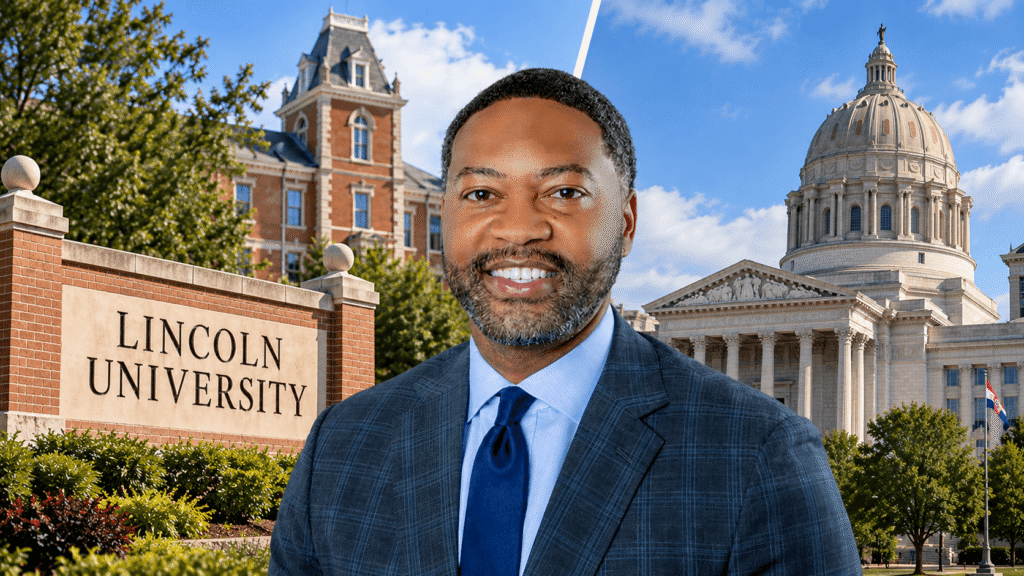
Table of Contents
A possible new challenge in the Lincoln University funding lawsuit
Seven current and former Lincoln University students filed the federal lawsuit on October 7, alleging decades of unequal funding compared with the University of Missouri.
The plaintiffs contend that the funding disparities violated their constitutional and civil rights and diminished educational opportunities at the historically Black university in Jefferson City.
During Tuesday’s interview, Calloway described what he believes is a more immediate problem: a formula that tied portions of Lincoln’s state funding to five performance measures.
Using a hypothetical $10 million federal allocation, he explained that Missouri should provide an equivalent state match. He alleged that the state instead divided its matching obligation into five portions, each contingent on Lincoln satisfying a performance measure.
Calloway argued that the state lacked authority to impose those conditions on money required for its land-grant obligations.
His team is now considering injunctive relief intended to stop the disputed practice before Missouri lawmakers develop the next state budget.
“We want to eliminate that very quickly,” Calloway said.
He characterized the formula as unconstitutional. No court ruling establishing that conclusion was identified during the interview, and Calloway did not say a new injunction request had already been filed.
Missouri law complicates the funding-formula claim
The question is more complicated than whether Missouri is permitted to use performance measures at all.
Missouri Revised Statute 173.1006 expressly calls for performance measures at public four-year institutions, community colleges and the state technical college.
A related provision, Section 173.1540, establishes rules for allocating increases in core state appropriations, including a performance-based component unless lawmakers provide otherwise.
Those statutes do not, by themselves, establish that Missouri could lawfully condition a federally required land-grant match on the same metrics.
But they also make it important to distinguish the state’s general higher-education performance-funding system from the particular federal matching obligation Calloway is challenging.
That distinction has not yet been resolved by the records reviewed for this report.
The Missouri Department of Higher Education and Workforce Development is also developing a revised statewide funding framework. Under a 2026 legislative directive, the department must submit a proposed formula and simulated allocations by December 1.
That separate process gives lawmakers another opportunity to examine how performance measures, institutional needs and legal funding obligations fit together.
Lincoln says it received a full federal match in 2024–25
There is another important piece of the record.
In a January 15, 2025 announcement, Lincoln University said it received a full state match for its federal land-grant funding during fiscal year 2024–25.
The university acknowledged earlier shortfalls. It reported receiving only $4.9 million of a required $9.75 million match in 2021.
Missouri’s fiscal 2026 higher-education budget materials also identify a $12.6 million appropriation for Lincoln’s agricultural extension federal funding match.
Those documents provide evidence of a substantial change from previous years, when state matching support fell short.
During Tuesday’s interview, however, Calloway said he believes Missouri has recently provided only about 75% to 82% of the required match.
It remains unclear whether Calloway was referring to a different funding calculation, a different period, additional research or extension requirements, or another component of the university’s appropriations.
The distinction matters because the central issue is not simply whether Lincoln has received more state money. It is whether Missouri has met every applicable funding obligation and whether any funding conditions unlawfully reduce that support.
Why $549 million may not be the settlement amount
The lawsuit’s nearly $549 million demand has drawn considerable attention.
But Calloway told Wake Up Jeff City that his team would consider settling for substantially less.
“We’re really just looking for the $361 million,” he said.
That figure is tied to a September 2023 analysis by the U.S. departments of Education and Agriculture, which estimated approximately $361.6 million in state funding disparities between Lincoln University and the University of Missouri over the 1987–2020 period.
The federal estimate compared state funding on a per-student basis. It should not be confused with a court ruling that Missouri owes that entire amount in unpaid annual matching grants.
The nearly $549 million litigation figure includes interest and reflects the plaintiffs’ requested relief, not an amount already awarded by a judge.
Calloway said his priority is securing funding that would help address the university’s longstanding needs rather than punishing the state.
He pointed to approximately $87 million in deferred maintenance, along with academic programs, staffing and student services he believes suffered because of historical funding decisions.
Who would control a settlement?
The attorney also explained how his team wants any recovery to be administered.
Rather than simply transferring the money to Lincoln University or the state, the plaintiffs are asking for an independently supervised remedial fund.
Calloway described a proposed federal court-appointed special master and a process requiring the plaintiffs and state officials to agree on spending priorities.
The purpose, he said, would be to direct the money toward problems allegedly caused by the funding disparity.
That proposal remains a request from the plaintiffs. A court has not ordered the creation of such a fund, and Missouri has not agreed to finance one.
For Jefferson City residents, the difference matters. A settlement could eventually support campus buildings, programs or services, but the amount, funding source, oversight and permitted uses would all depend on the terms of an actual agreement or court order.
Calloway acknowledges voting for budgets he now challenges
The interview also produced an acknowledgment from Calloway about his own time in the Missouri House of Representatives.
“I sat in the legislature and voted on budgets that … underfunded Lincoln,” he said.
He argued that legislators often relied on complicated funding formulas without fully understanding their effects.
Calloway credited Republican officials, including former Gov. Mike Parson, with progress toward meeting Lincoln’s matching obligations. He also said Democrats bore a substantial share of the historical responsibility for the funding disparities.
But he did not place the blame exclusively on one party. He acknowledged that Republican lawmakers also maintained the system and described the issue as one that should be addressed across party lines.
His account reinforces a question that goes beyond the pending lawsuit: If lawmakers in both parties approved the funding arrangements for years, how will the legislature determine whether those arrangements met the state’s obligations?
What happens next?
Calloway said there have been no substantive settlement negotiations with Missouri officials since the lawsuit was filed.
He reported that the state had accepted service and that his team anticipated discussions before the end of the year.
He also said the 1890 Project is working with lawmakers on legislation intended to address both historical funding disparities and future appropriations.
Looking ahead six months, Calloway said he hopes the case will survive expected efforts to dismiss it and that more serious settlement discussions will be underway.
Those are his expectations, not established court deadlines or commitments by the state.
The central unresolved questions are now specific:
What funding did Missouri legally owe Lincoln in each relevant year? Did the state apply performance conditions to required federal matching dollars? Do any such conditions remain in effect? And how would a proposed settlement be paid for and supervised?
Lincoln University has acknowledged past deficiencies in its federal matching support and reported more recent progress. Calloway contends that the wider funding problem remains unresolved.
Whether his team pursues immediate injunctive relief or continues solely through the existing lawsuit and legislative process, the next meaningful development will be a documented legal filing, a concrete state response or an actual funding proposal.
Until then, the nearly $549 million demand is a claim before the courts, not a bill that Missouri taxpayers have been ordered to pay.
Don Calloway Jr. discussed the Lincoln University funding lawsuit during the October 20, 2026, edition of Wake Up Jeff City, hosted by Brad Boeckmann on 4Liberty Network.
Leave a Reply