
By Regular Guy Guns | Opinion
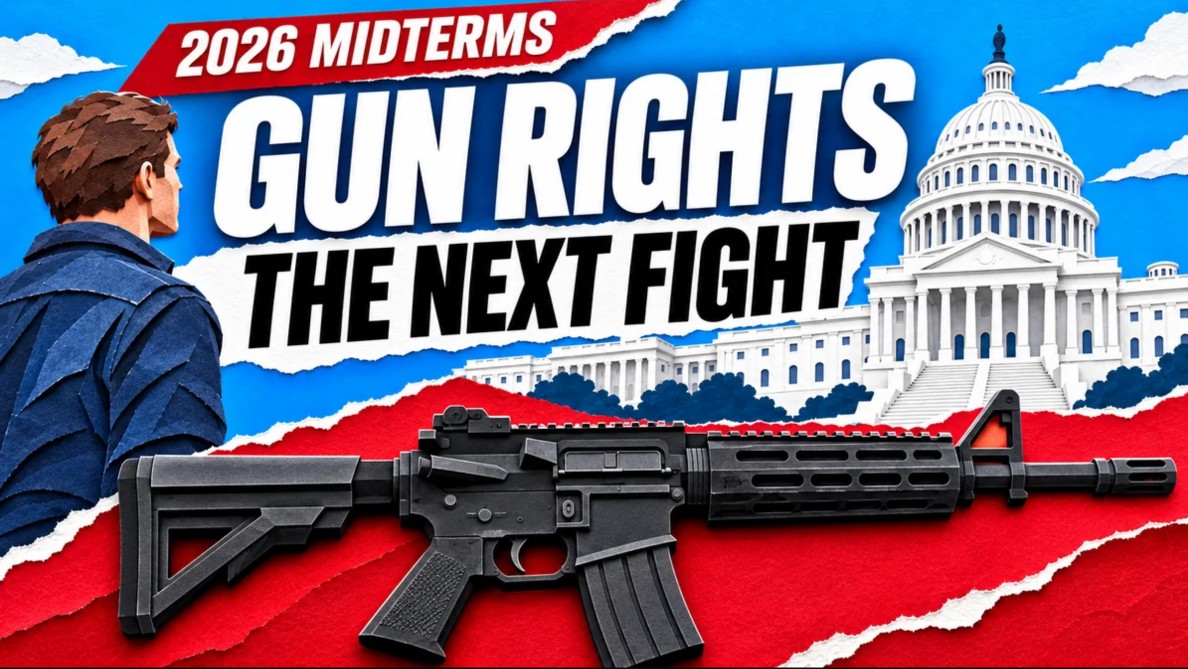
Ask any gun owner or Second Amendment advocate worth their salt what the political weather looks like after the 2026 midterms on November 3rd, and the answer is simple: the map got uglier. Voters walked into the booths with grocery receipts in one hand and elevated gas prices in the other. They walked out having handed Democrats both chambers of Congress. The blue wave was not quite the extinction-level event Ron DeSantis called it from Tallahassee, but it was close enough. Blue states, red states, and everything in between took hits.
Florida and, to a lesser extent, Tennessee held the line with any claim to pride, and even those claims required some creative accounting.
This is not the end of the argument. It is a warning shot. The underlying reality of an armed citizenry that treats the Second Amendment as a right rather than a suggestion did not disappear overnight. The question is whether the people who understand that distinction will treat the next two years as a holding action or a surrender.
In this article
2026 Midterms: What Actually Happened
Even Florida—the supposed gold standard of Republican durability—barely held. Byron Donalds scraped out a win for governor at roughly 50 percent against David Jolly. That margin made DeSantis’s old landslides look like a fever dream. In the Senate race, Ashley Moody edged out DSA-aligned Angie Nixon by about three points. Three points. In Florida. Against a candidate who joined the Democratic Socialists of America and still came within shouting distance of a Senate seat. Nixon carried Miami-Dade and posted numbers that would have been unthinkable two years ago. Miami, Cubans, wait what?
The Free State of Florida stayed red, but the battle line moved in close. That is not a hold. That is a warning shot.
Then there was Texas. The Lone Star State, long the poster child for pro-2A swagger, watched Democrat Gina Hinojosa take the governor’s mansion from Greg Abbott and James Talarico flip the Senate seat against Ken Paxton. Democrats also seized control of the Texas House for the first time in decades. In the race that mattered most to the gun community, Katy Padilla Stout defeated Brandon Herrera in TX-23 by roughly 52 to 44. Herrera, the AK Guy, was supposed to be a blowout in a district Trump carried by double digits.
Fatigue from Paxton’s endless corruption saga—impeachment by his own party, the divorce on “biblical grounds,” the Dubai stories—dragged the entire ticket. What looked like a sure win turned into an eight-point loss. Some suspect fraud, but let’s be real – if there was, no one has ever done anything about it. On this issue, and many others, voters expected arrests and maybe even some life sentences. Where are the shackles if not upon the people themselves?
Georgia followed a similar pattern with Bottoms winning the governorship and a split legislature. Pro-2A strongholds did not just lean blue. Several of them flipped hard. Texas and Georgia were supposed to be the firewall. Those firewalls are on fire.
Let’s Play The Blame Game!
The incumbent party almost always takes a beating in the midterms. This particular beating had fingerprints all over it, and they belonged to the guy at the top. Trump’s decision to draw out the Iran war created an economic drag that no amount of border rhetoric could fully paper over. Gas prices stayed elevated. Grocery bills stayed ugly. Voters who pulled the lever for Trump/Vance in 2024 decided they had seen enough.
JD Vance put the post-mortem in writing on X the morning after, and it was more honest than most Republican postmortems ever get. “The reason we lost is the war,” he wrote. “The president himself said so last night.” He listed the four things a trusted pollster said would bring those 2024 voters back: end the war, focus on cost of living and inflation, put America First, and change the relationship with Israel. Our voters showed up. In Florida the electorate was still several points more Republican than Democratic. The problem was not catastrophic turnout collapse.
The problem was that a meaningful chunk of the people who voted for Trump and Vance in 2024 voted for Democrats this time. Trump later called the assessment “largely true” while still defending the war itself. That is the tell.
When the Vice President is publicly saying the signature foreign policy choice cost the party both chambers, and the President is nodding along while refusing to change course, you do not have a messaging problem. You have a policy problem that walked into the voting booth wearing a MAGA hat. Democrats did not need a brilliant positive agenda. They just needed the GOP to keep stepping on its own rake. They got their wish.
As the noted geriatric gun-grabber James Carville says, “It’s the economy, stupid.” Being principled is easy. It is not so easy when a gallon of gas costs five dollars and a trip to the Food Lion means you are taking out a mortgage.
A Democrat Congress and a GOP White House?
Trump has already said he will be vetoing things left and right. Expect that. A divided government with an energetic veto pen is not the same as unified Democratic control. Anyone claiming otherwise is either selling panic or selling consulting hours. The practical reality is uglier in a different way: prominent Democrats have already made it clear their primary project is revenge, not governance. Within hours of the results, the tone on X shifted from affordability to lawfare.
Prominent Democrats immediately signaled a revenge tour of subpoenas and investigations aimed at Trump allies, Musk, and DOGE figures. This is not subtle. What does that mean for actual legislation that helps people? Not much. Expect hearings, subpoenas, and performative outrage. Expect gun control bills floated as political tools rather than serious lawmaking. Democrats know Trump will veto anything that reaches his desk, so the point is not passage. The point is the press release, the fundraising email, and the base activation. A few AWB-style measures or magazine restrictions might get votes in the House. They will likely die, maybe even in committees.
The real business of Congress will be the revenge tour. That is not ideal for the country, but for gun owners it is a perverse short-term benefit: when the other side is more interested in settling scores than writing statutes, fewer statutes get written.
The Supreme Court Is Not Safe!
Congress being blue creates a real threat to the Supreme Court, especially if Clarence Thomas or Samuel Alito decide they have had enough. Both are in their seventies. Neither has given any public indication of retiring while Trump is in office, but health is not a campaign slogan. If either steps down before 2028, the replacement fight happens with Democrats controlling the Senate. That is not a friendly environment for an originalist who treats the Second Amendment as something other than a suggestion.
The confirmation process for a replacement would be ugly, protracted, and almost certainly produce a justice less protective of the individual right to keep and bear arms.
The courts remain the backstop when legislatures turn hostile. That backstop is aging.
What This Means at the State Level
In hard blue states, the fight continues the way it has for years: through the courts and the rare friendly legislator who can still force a vote or an amendment. That work is unglamorous and necessary. Texas and Georgia are different in a key way, and those differences are why all is not lost.
In Texas, Democrats flipped the House and the governor’s office, but Republicans still hold the Senate. That chamber can block the worst of what Hinojosa and the new House majority want to do. In Georgia, current data point to a Democratic House and a Republican Senate. The electorate there has a habit of splitting tickets in ways that frustrate both parties. You’ll see single-family homes with the sign for a Democratic US Senator and a GOP state rep on the same lawn. In both states, the legislature does not have the votes to ram through anti-2A bills without serious resistance.
That buys gun owners a modicum of a reprieve. It also means the burden falls on gun owners themselves to lean on their remaining GOP legislators and remind them that blocking bad bills is the job.
A blue wave is not the same as a permanent realignment. Where one chamber or the governor’s veto pen remains in less hostile hands, the legislative machinery slows down. That is not a victory parade. It is breathing room.
The Real Legislative Threat: Restoring the NFA Tax
The one real threat that deserves focused attention is the danger of Democrats sneaking a restoration—and increase—of the NFA tax into some must-pass vehicle. Chris Murphy already floated an amendment that would jack the transfer and making taxes on silencers, short-barreled rifles, and similar items to $4,709 per item, an inflation-adjusted return to the original 1934 prohibitive rate. Other Democrats have proposed restoring the tax to fund Medicare expansions.
The $0 tax created by the One Big Beautiful Bill, combined with the August 2026 district court ruling in Silencer Shop Foundation v. ATF that treated the zeroed tax as removing the constitutional basis for the registration scheme, is what produced the current injunction and ATF’s nationwide non-enforcement posture. Restore even a token tax and the foundation of that injunction gets shaky. Dissolution becomes possible. The people who bought silencers and SBRs on a Form 4473 under the current rules could find themselves in a compliance gray zone with no automatic grandfathering.
The NFA was never a perfect statute. It was a tax scheme that the courts have now treated as constitutionally limited once the tax hit zero. Putting the tax back, especially at a punitive rate, is the cleanest way for opponents to reopen the fight without having to pass a new ban. Overall, legislative advances on the Second Amendment at the national level are dead for the foreseeable future. Policy wins remain possible in Florida and the remaining red states that still have the political will to move them. Everywhere else, the only reliable advances for a while will come through the courts nullifying laws.
What Second Amendment Supporters Can Actually Do
In states like Texas and Georgia, the immediate job is simpler and more urgent. Contact your 2A-friendly legislators. Remind them, politely and repeatedly, that their duty is to be blockers. Any anti-2A bill that escapes committee is a failure of the people who still hold the gavel in at least one chamber. Make the phone calls. Show up at the district office. Be the constituent they cannot ignore without political cost.
Another mode of defense is local. Reach out to county commissioners and sheriffs and revive the Second Amendment Sanctuary concept—but with teeth. The Kansas Second Amendment Protection Act is the model worth studying. It declares that firearms, accessories, and ammunition manufactured and owned in Kansas and remaining in the state are not subject to federal regulation under the commerce clause, and it prohibits state and local officials from enforcing federal acts that violate the Second Amendment. The statute has not been upheld against every challenge, and federal courts have still convicted people who relied on it alone, but the framework exists.
A sanctuary law with actual enforcement language, private rights of action, and penalties for officials who assist in unconstitutional enforcement creates both a constitutional and a practical defense.
If the state or the feds get pushy, the county has something on the books that is more than a resolution. Encourage your local officials to look at the Kansas statute and the later Gun Rights Preservation Act proposals and adapt the workable pieces. “Irish Democracy” starts with people who refuse to treat unjust laws as legitimate. A county that will not assist in their enforcement is one practical expression of that refusal. The point is not to declare independence from the United States. The point is to create friction against the enforcement of laws that treat a constitutional right as a privilege.
None of this is lost if gun owners treat the next two years as a holding action rather than a surrender. Spread the good word of Second Amendment Radicalism. Buy guns. Train with guns. Buy ammo. Make guns. Learn how to 3D print if you have not already. Buy bitcoin. The technology and the knowledge are already in the wild. Can’t stop the signal. Gun rights only die if we let them.
Focus on 2028 and any intervening special elections. The midterms were a setback. They were not the end of the argument. The electoral setback does not erase the knowledge base or the manufacturing capacity or the cultural shift that made suppressors and short-barreled rifles ordinary tools instead of exotic curiosities. It just means the next gains will be harder and the defense of the existing ones will matter more. You do not need permission from Congress to keep training, keep teaching, and keep making the case that an armed citizenry is the last line of defense against every other kind of overreach.
The midterms change the political weather. They do not change the underlying physics of an armed people who refuse to treat their rights as negotiable.
Leave a Reply