
By Regular Guy Guns | Guest Author
Table of Contents
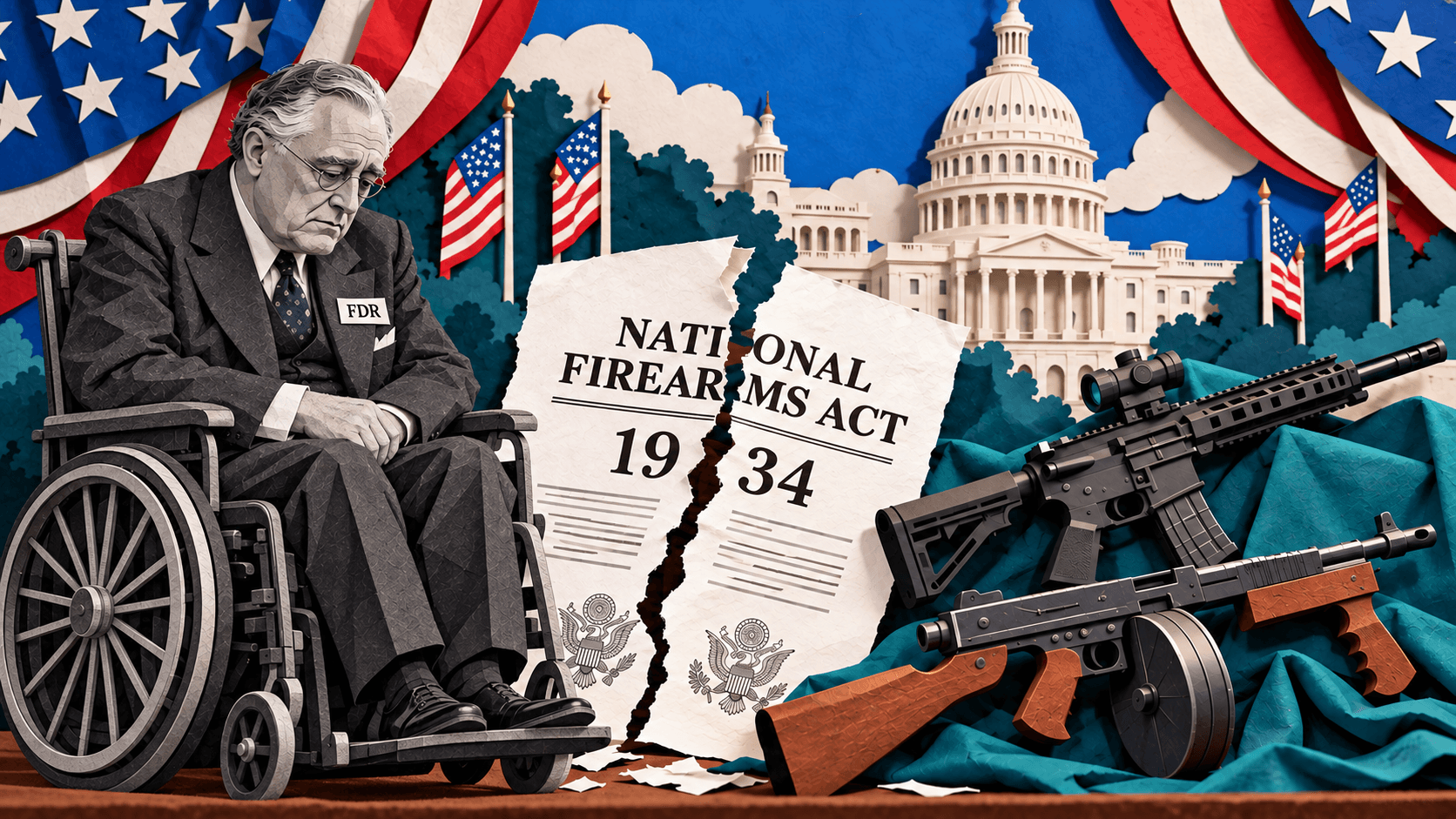
Ask any gun owner or Second Amendment advocate worth their salt, and the biggest bugaboo of them all in the scene is the National Firearms Act of 1934, aka the NFA. For those just getting up to speed, the NFA traditionally has levied onerous taxes (traditionally $200, but more on that in a minute), processing times, and registration requirements on certain types of weapons and accessories deemed “uniquely dangerous” by the government.
The types of firearms and accessories affected by the NFA are: short-barreled rifles (firearms with a rifled bore with a stock and a barrel length less than 16 inches long), short-barreled shotguns (smoothbore weapons with a stock and barrel length less than 18 inches), machine guns (any firearm that discharges multiple bullets with one singular action of the trigger), silencers (any device that makes a gun quieter), destructive devices (missiles, grenades, etc) and Any Other Weapon (weird things like pen guns, cane guns, pistols with vertical grips etc).
Traditionally, the tax assessed on all these items, save for AOWs, was $200 per item. AOWs were assessed with a $5 tax. Upon payment of the tax and successfully passing a NICS inquiry, the item in question was registered and a tax stamp issued to the owner. Interestingly enough, this provided a thin veneer of Constitutional cover for the NFA, since by this metric it was a tax measure and not a gun control law.
The dam held, until 2025 when Representative Andrew Clyde of GA-9 introduced the Clyde Amendment to Donald Trump’s One Big Beautiful Bill. The OBBB was a budget bill, and since the NFA was a tax, the Clyde Amendment kicked the tax on silencers, SBRs, and SBSs, and AOWs to $0. The idea here was to take away the legitimacy of the NFA, since if there’s no tax levied, why should the NFA apply to these items?
As an aside, the original draft of the Clyde Amendment was to remove these items from NFA purview entirely, but the Senate Parliamentarian ruled against this specific caveat, arguing that registry removal was a gun control matter and not a tax matter. Ironically she set the stage for the rapid rush against the NFA this past year.
And what a rush it has been. On August 5th, 2026, U.S. District Judge James Wesley Hendrix of the Northern District of Texas handed down a final judgment in the consolidated cases of Silencer Shop Foundation v. ATF and Jensen v. ATF that punched a massive hole straight through the heart of the National Firearms Act of 1934. The injunction took full effect on August 13 after the government failed to seek emergency relief. The decision ruled that since the NFA was a tax, and if there’s no tax, why should there be a registry?
The enjoined plaintiffs had to be a current or future member/customer of the Gun Owners Of America, Citizens Committee for the Right To Keep And Bear Arms, Texas State Rifle Association, Palmetto State Armory, and some other similar groups. For those covered groups, the NFA tax and registration requirements no longer applied, provided no state laws prohibited NFA item possession, or required an NFA tax stamp as an affirmative defense.
Then, after many hints and rumors, the other shoe dropped on October 9th, 2026. On that day, ATF Director Robert Cekada not only said the ATF would not be pursuing the cases (The appeal period expired October 5th), they would also not be enforcing the National Firearms Act on anyone in the nation as it applies to silencers, SBRs, SBSes, and AOWs – not just the GOA members etc, but anyone.
To say the game is on is to put it mildly. Historic, really. Earth-shattering.
But, how did we get here, where are we and where do we go next?
A brief history of the National Firearms Act Of 1934
The National Firearms Act of 1934 was peddled as a response to Prohibition-era gang violence—the St. Valentine’s Day Massacre, Dillinger’s Tommy-gun bank jobs, Bonnie and Clyde—but that was the public marketing. The real goal, pushed by Attorney General Homer Cummings and the New Deal crowd, was to tax and register guns out of existence because a straight ban risked running into the Second Amendment. Cummings openly treated the taxing power as a workaround: impose a prohibitive $200 stamp (roughly $5,000 in today’s money) plus registration, and ordinary ownership becomes impractical.
The original draft (H.R. 9066) was far broader and included ordinary pistols and revolvers; that proved too expansive for Congress, so it was pared back after pushback led by the NRA. Short-barreled rifles and shotguns were deliberately added to the final law precisely to block the obvious workaround—sawing down the remaining exempt long guns into concealable “pistols” once handguns were stripped out.
All of this landed amid Depression-era labor unrest, when industrial interests were already arming private police and strikebreakers with the same machine guns the NFA targeted, while progressive reformers built a federal framework that made private ownership a tracked, taxed privilege rather than a right.
From the 1968 Gun Control Act fixes (after Haynes blew up the original registration scheme on self-incrimination grounds) through the 1986 Firearm Owners’ Protection Act and its Hughes Amendment that froze the civilian machine-gun registry, the NFA has survived as the template for federal control-by-tax-and-paperwork. The $200 tax stayed frozen for decades as an intentional barrier. Even the 2025–2026 changes that zeroed the tax on suppressors, SBRs, SBSs, and certain AOWs—and the subsequent ATF non-enforcement posture on registration for those items—leave the machine-gun and destructive-device rules, the registry architecture, and the underlying philosophy intact.
The public crime story never matched the legislative history; the through-line has always been using revenue power and registration to shrink private ownership while elites retained their own arsenals.
Where Are We Now With The NFA?
Where we are is in a very interesting place. In the bulk of the nation, any citizen who can pass a federal NICS (firearms-specific background check) inquiry can purchase a silencer, short-barreled rifle, short barreled shotgun, or AOW from any federally-licensed firearms dealer. The process is no different from buying a pistol or non-NFA rifle or shotgun. Fill out 4473, clear NICS, pay and take new toy home.
For SBRs and SBSs, the completion of a NICS check qualifies as “Attorney General Approval” that the GCA requires of those specific NFA items. Provided there’s no interceding state laws of course. Right now, the ATF will not enforce or prosecute these people and shops. Remember, the NFA still stands, and only GOA etc members are truly enjoined from being prosecuted.
Being Prosecuted? Isn’t The NFA Dead?
Is the National Firearms Act Dead? No. The body blow was two-fold but not deadly. The court decision only enjoined the covered plaintiffs from being prosecuted in the future (barring insane legal maneuvering or a damn-the-torpedoes approach by the progressives), whereas everyone else is only not going to be prosecuted because the ATF is choosing not to do so.
The Act still stands, there’s still a $200 tax on machine guns and destructive devices, and for SBR and SBS owners, they still have to notify ATF if they move those items across a state line, which would be tantamount to registering them, albeit on a Form 20.
As for being prosecuted, the ATF merely chose to use it’s operational powers to not prosecute. They could easily do so tomorrow. Plus there’s the bugaboo of state laws regarding the NFA.
The State Laws
Much like with other things related to firearms, the States have their own laws regarding NFA items. The obvious states, i.e. California, New York, etc still have total bans on NFA item ownership. Even if you could get your silencer stamped in those states, it would not protect you from state prosecution. You’re pretty much up a creek at that point.
Several other states lie in a grey area. Georgia, Alaska, and a surprising amount of 2A-friendly states lie in this area. The requirement in those states is often something along the lines of “Your tax stamp is your defense against us prosecuting you for illegal NFA item ownership”. Even Florida has a vague statement about SBRs, where “federal compliance” is required. However, it seems the Florida government interprets passing the background check as “compliance”.
That being said, some shops in the grey states are selling silencers and SBRs on a 4473 despite state laws, most notably Mammoth Arms in Griffin, Georgia
For grey states though that don’t have daring FFLs, NFA items can still be processed the old way.
And of course the free-er states – Texas, Florida, Missouri, and so forth, there’s no specific need for regulatory maneuvering or outright defiance like the shops in Georgia. Go to shop, pick can, fill out 4473, clear NICS, pay, go home with can, or SBR.
What About Making A Suppressor Or SBR?
Even better in most cases. Making, i.e. printing a suppressor or throwing a stock on an AR pistol, is covered by these decisions. This in and of itself is an extremely important caveat, as will become readily apparent.
Where Are We Going With The NFA?
The National Firearms Act Of 1934 is not dead. The registration requirements for all the items traditionally covered by the Act exist. A $200 tax exists still for machine guns and fun stuff like grenades and missiles. Congress has not struck the NFA down, and neither have the courts. The law is enjoined for certain people and items, and the ATF currently won’t enforce the law as far as those items are concerned, for everyone – at this time.
Moving forward, there’s a chance the ATF could reverse it’s decision. Director Cekada, by all intents the best ATF Director in history, could be forced to change his mind on enforcement. Tomorrow ATF IOIs (compliance agents) and armed agents could be going to every FFL demanding to see their logs and bound books to start enforcing the NFA on uncovered people again. A future administration could remove Cekada, restore enforcement, and the same thing happens.
Congress could restore the tax even to a dollar, thereby nullifying the Clyde Amendment and destroying the basis for the Jensen/Silencer Shop decision.
ATF explicitly warns about this, by the way. The buyer assumes the risk of future enforcement, and there’s no guarantee of an amnesty or grandfathering even. A future Congress and President could restore the tax, killing the injunction, and as soon as the ink is dry on the budget bill, federal law enforcement goes out and tracks down the people who got cans and SBRs on just a 4473. By the time a court intercepted that move, the bullets are already flying.
On a more positive note, Congress could choose to amend the National Firearms Act, at least to the degree that the items covered by the Clyde Amendment are no longer NFA items. This would be a gun bill and not a budget bill, so in the Senate at least there’d have to be a supermajority vote, or some clever needle threading in a budget bill to only require a simple majority, and also the desire to ignore the Senate Parliamentarian. However, there has not been a successful pro-2A law passed by Congress in 30+ years, so as the kids say “good luck”.
The other positive route would be court action. As of this writing, other NFA cases are winding their way up the Federal ladder, such as Robers vs ATF. If another case rules in favor of the NFA rather than against it, a possible circuit split happens, and thus provides ammo to get the NFA to the Supreme Court, at least for the items named in the Clyde Amendment. This would be the more likely path since the courts thus far have proved amenable to pro-2A decisions. Bruen, Hemani, etc…
The value of a legislative or judicial fix as opposed to an injunctive or operational fix is that it’s more durable. The Courts act decisively, or Congress does, and it takes a serious amount of work to undo it.
That being said, don’t expect machine guns and missiles to come off the NFA anytime soon. Even the pro-2A government entities have carefully sidestepped machine guns, mainly due to cultural misconceptions and the desire to actually deliver incremental wins rather than decisive losses. Rights taken incrementally must be regained incrementally, if peace is to be maintained.
What Gun Owners Can Do Now
The war isn’t over. A battle has been won, and let’s be real, the Second Amendment community has earned the long weekend off. But immediately, the community has to act. Ring up your Congress members. Join your local and state 2A organizations – especially GOA and the like so being covered is a reality.
If you live in a grey area state, contact your state-level reps, contact your AG, your DAs, the sheriffs, the mayors, everyone. Support your grey area shops like Mammoth Arms who dare to take the fight to the face of the enforcers.
If you live in a total NFA ban state, join your local 2A group – remember Bruen was won by the New York State Rifle And Pistol Association, not a “free-er” state 2A group. It’s often those behind enemy lines winning decisive victories for us all.
If you live in a free-er state, buy those cans. Buy those SBRs. Make those cans. Make those SBRs. For the latter, you can literally convert an AR pistol to an SBR for $80 and 20 minutes worth of work. The idea here is to flood the nation with silencers and SBRs, making even future enforcement impossible on a practical level.
They can’t get everyone, and those they do become defendants in potentially a hot 2A case that could define a generation. It may not be pretty, and it could be expensive, but sometimes the price of freedom isn’t glamorous.
Gentlemen (and ladies!) get to work. The Second Amendment speed-run in progress is bearing fruit, but the battles continue.
Don’t take any guff from those swine.
Leave a Reply