
By Olga Maria | Opinion
Table of Contents
New Hampshire invitation follows $118,000 Amish school fines
Three privately funded, Amish-run one-room schools in upstate New York have been fined a combined $118,000 for allowing unvaccinated children to attend. The schools take no public money. They sit on private farms. They educate only Amish children in the traditional manner. New York’s response has been escalating civil penalties under a 2019 law that eliminated the long-standing religious exemption to school immunization requirements.
In Miller v. McDonald, Amish parents and school representatives (including Joseph Miller, Jonas Smucker, and Ezra Wengerd) argued that the mandate conflicts with their religious beliefs and way of life. District and appellate courts have so far sided with the state, treating the rule as a neutral law of general applicability.
A new petition is now before the Court. New York has indicated that each day an unvaccinated student attends can be treated as a separate violation carrying a fine of up to $2,000. Counsel for the families has stated that the community could satisfy judgments of this size only if the state takes land. Some Amish have spoken of leaving the state.
Amos Miller’s farm and successive enforcement actions
This is not an isolated episode of regulatory pressure on people who prefer to remain separate from state systems. A longer pattern has emerged of successive federal and state actions against Amish and Plain communities that raise their own food, educate their own children without public funding, largely decline conventional medical interventions (including vaccines), and operate outside Social Security participation for religious reasons.
The clearest recent food example is Amos Miller’s Organic Farm in Bird-in-Hand, Lancaster County, Pennsylvania. The farm has sold raw dairy, meats, and other traditional foods through a private membership association serving roughly 2,000 buyers, many of them non-Amish customers seeking direct, minimally processed products.
Federal authorities opened a multi-year enforcement campaign against Amos Miller’s farm after linking a 2015 sample of its raw chocolate milk to a listeriosis outbreak through genetic relatedness. The campaign involved repeated USDA inspections, product seizures, and prolonged court supervision that culminated in a 2023 consent decree.
Defense attorneys, including Robert Barnes, contested any causal connection, citing testimony that the deceased woman in question had never consumed Miller’s products.
The sustained federal pressure; inspections, detentions, and legal constraints focused on the on-farm processing and functioned more as ongoing intimidation of a producer operating outside conventional regulatory channels.
In January 2024, Pennsylvania stepped in after reports of Shiga toxin-producing E. coli illnesses in children in New York and Michigan who had reportedly consumed raw eggnog or related products from the farm. The state executed a search warrant and filed a civil lawsuit centered on the absence of a raw-milk permit and other regulatory requirements. Testing of farm samples was negative and no confirmed match to the clinical strains was established.
Defense filings characterized the warrant as relying on overstated or misleading statements and argued that the illnesses were never conclusively tied to the farm. The health claims that triggered the raid have not been proven in court as a basis for permanently closing the operation.
Self-reliance, voluntary exchange and the Live Free or Die outlook
The sequence, federal action first, then state, shows successive enforcement against producers who operate through voluntary membership associations rather than conventional retail channels and who supply demand from both inside and outside their communities. Vaccines and local raw dairy or meat sit on the same continuum for these groups: they involve communities that limit dependence on state-approved medical and food systems, educate and feed their own, and often extend those options to neighbors who want them. Amish schools take no taxpayer funds. Their farms frequently supply regeneratively raised products to customers who prefer direct relationships.
Studies have documented lower rates of certain chronic conditions (including some cancers, type 2 diabetes, and hypertension) among Amish populations, correlated with high physical activity, traditional farming exposure (the “farm effect”), diet, low tobacco use, and strong social networks.
What these communities represent is a working model of self-reliance that does not require the administrative state to function. They govern their own education, feed themselves and others through voluntary exchange, and decline systems that demand participation as a condition of ordinary life. That independence is precisely what successive enforcement actions treat as a problem to be solved through fines on private schools, raids and injunctions on private farms, and the steady pressure to conform or leave.
The Live Free or Die outlook that freestaters and others in New Hampshire support does not demand that everyone live as the Amish do. It does require refusing to use state power to erase communities whose defining features are voluntary association, refusal of public funds, and the ability to sustain themselves outside distant bureaucratic control. New York’s vaccine enforcement on private Amish schools and Pennsylvania’s multi-year handling of the Miller farm illustrate the same impulse: uniform compliance preferred over accommodation of groups that largely govern themselves.
Why Free Staters invite self-reliant communities to New Hampshire
New Hampshire has drawn thousands of individuals and smaller intentional communities who share that preference for greater personal responsibility and less government interference in education, food production, and daily life. Groups such as the Catholic Land Movement have established a growing presence there, seeking land and arrangements that allow families to produce their own food and raise children with less entanglement in distant systems.
For Amish and other Plain producers already weighing whether continued fines, raids, or land pressure make staying viable, the state offers a practical alternative grounded in the same Live Free or Die distinction: space for self-reliant producers who take no public funds and prefer voluntary exchange. The invitation is straightforward, those who demonstrate resilience outside the administrative state are welcome to consider New Hampshire.
New Hampshire education, food and parental-rights legislation
New Hampshire’s Senate and House are Republican-controlled and have spent recent sessions advancing measures that reduce state interference in education, food production, and parental decisions, outcomes shaped by a concentrated presence of liberty-focused residents and activists who prioritize self-reliance over administrative mandates.
In 2026 the legislature passed and the governor signed HB 1268, the Home Education Freedom Act, which ends mandatory notification, annual evaluations, and recordkeeping for most homeschool families and affirms a parent’s right to direct their child’s education with greater privacy.
The same chambers passed HB 396 to permit limited on-farm processing and in-state sale of beef, pork, sheep, and goats outside USDA facilities (addressing slaughterhouse bottlenecks), although not signed by the governor, the effort itself shows the body’s willingness to test barriers that constrain small producers.
HB 10, the Parental Bill of Rights enacted in 2025, codifies parents’ authority over moral, religious, and educational choices and limits school interference absent a compelling interest.
Attempts continue to simplify religious vaccine exemption forms or repeal immunization requirements outright. The state already maintains medical and religious exemptions, and a narrower 2026 measure requires the Department of Health and Human Services to clearly note their existence.
A New Hampshire invitation to Amish families and independent producers
These results stand in contrast to the escalating fines on private Amish schools in New York and the multi-year federal-then-state actions against independent producers in Pennsylvania.
For Amish families and other self-reliant producers weighing whether continued regulatory pressure makes staying viable, New Hampshire’s Republican majorities and the ongoing legislative focus on voluntary education, direct food systems, and parental authority offer a concrete reason to examine whether the state’s Live Free or Die framework provides more durable ground for communities that educate their own, feed their own, and decline systems that demand conformity as the price of ordinary life.
Free Staters, liberty-minded neighbors, and others who live by New Hampshire’s Live Free or Die motto welcome Amish families and other self-reliant producers seeking a place where they can educate their own, feed their own, and continue their way of life with less interference from the administrative state.
Related resources: Free State Project moving resources and more politics coverage from 4Liberty Network.
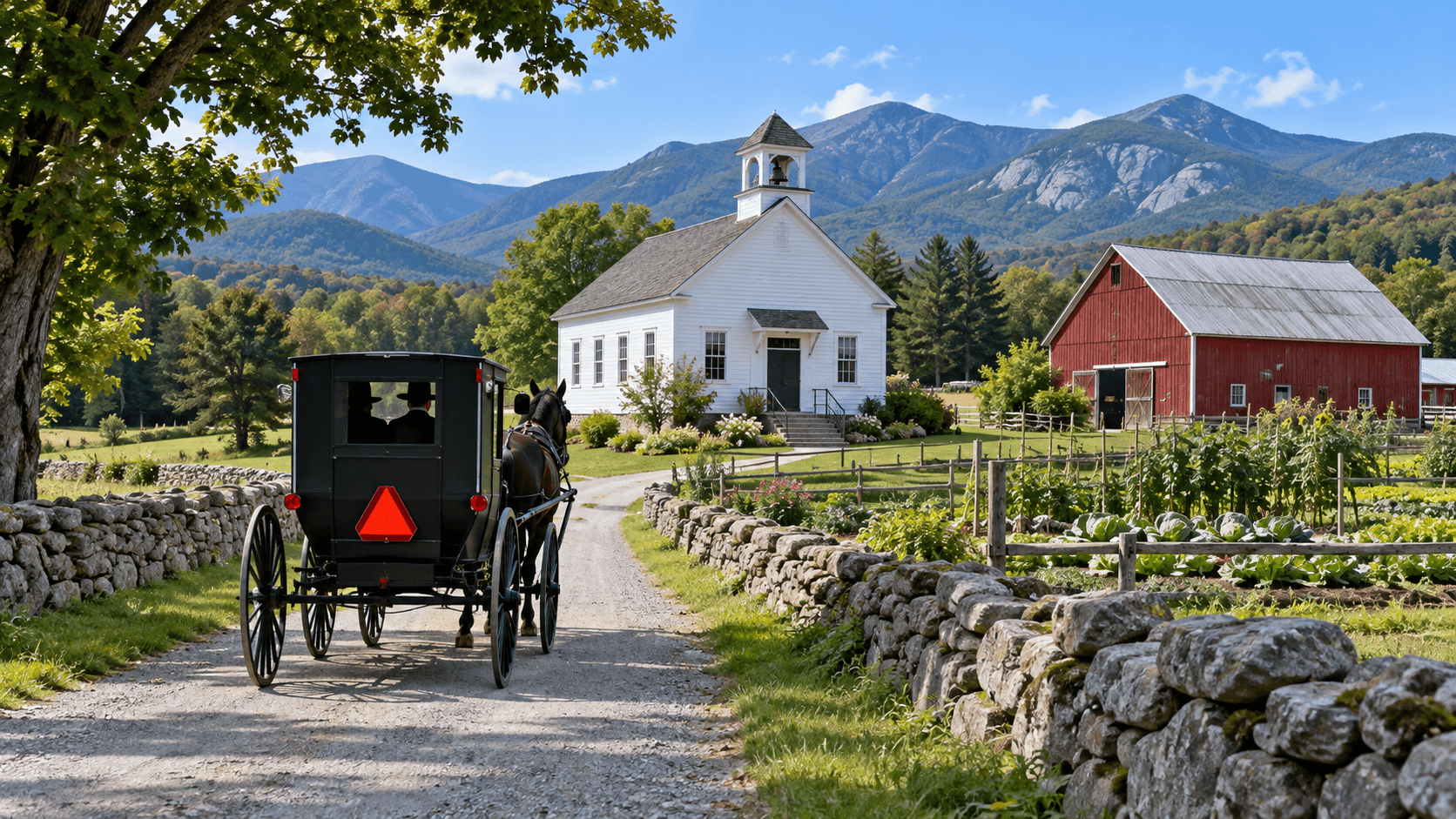
Featured image: AI-generated conceptual illustration of rural self-reliance in New Hampshire.
Leave a Reply