
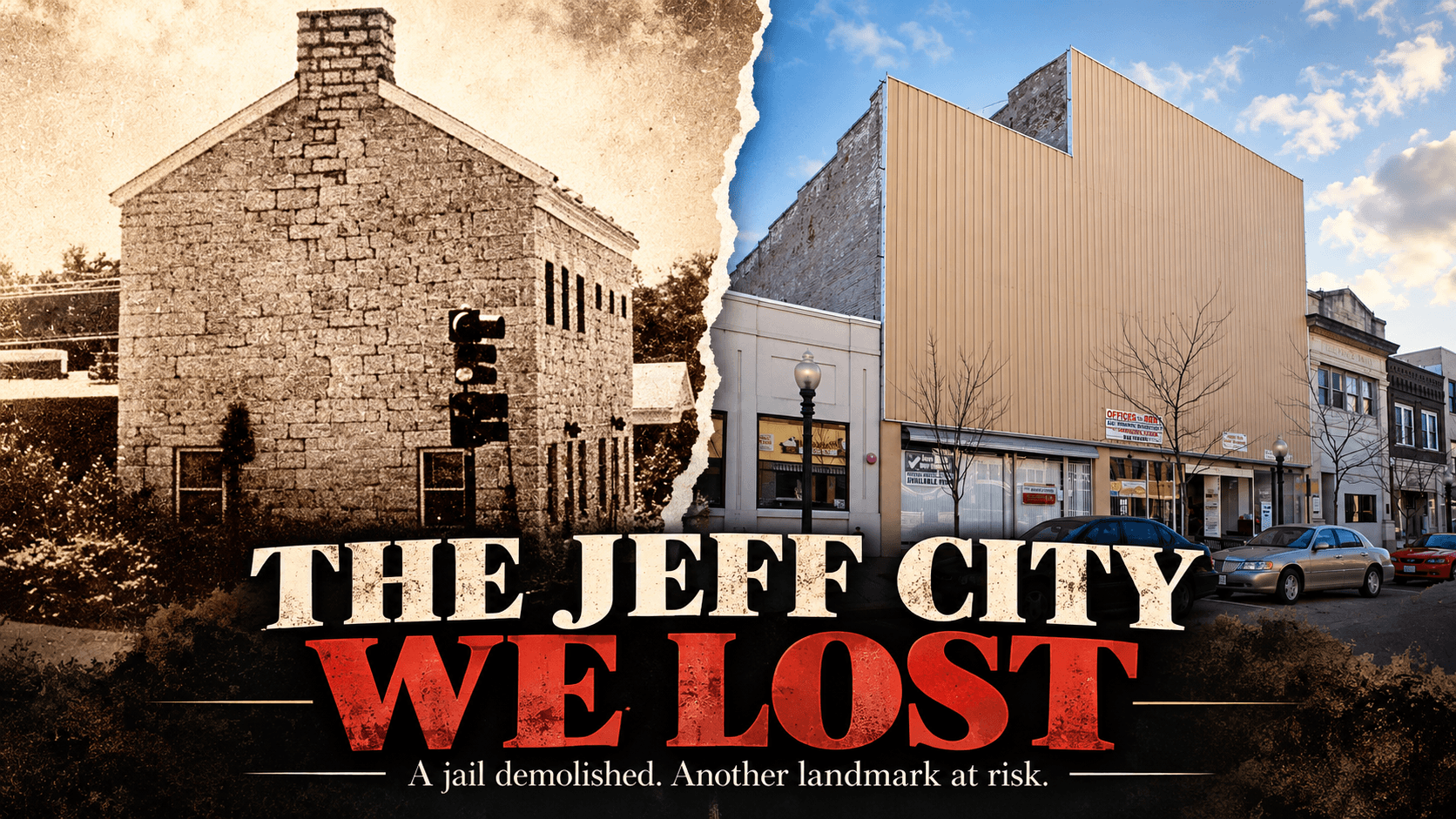
As Jefferson City considers the future of the former J.C. Penney building on East High Street, its history offers a warning about what can happen when preservation decisions come too late.
Jefferson City once had a jail built in 1842. It survived for 140 years, through the Civil War, two world wars and generations of change in Missouri’s capital.
In February 1982, the City Council voted 5–4 against a proposal to preserve it.
Nine hours later, demolition was underway.
That decision helped inspire a local preservation organization that still exists today. And it is part of a larger story about Jefferson City historic buildings: some were destroyed, some narrowly escaped demolition, and others are still waiting for someone to decide whether they have a future.
Now, the former J.C. Penney building at 206–210 E. High Street has brought those questions back.
The building has deteriorated for years, and city officials are preparing for the possibility of demolition. No final demolition order has been announced, and the property’s future remains uncertain.
But Jefferson City has faced this kind of decision before.
Table of Contents
The 1842 jail: demolition began nine hours after a vote
At East McCarty and Monroe streets once stood the old Cole County Jail, built in 1842.
Constructed from limestone with walls approximately two feet thick, the building was among the oldest surviving jails west of the Mississippi River.
By the late 1970s, Jefferson City was developing a new police department facility. Officials considered several possibilities for the old jail, including preserving it as a separate museum or cultural center.
Preservationists sought to keep it standing.
The Missouri Heritage Trust proposed a lease arrangement, supported by available preservation funding and private pledges. Supporters envisioned a city museum and visitors center.
The City Council considered that proposal on February 1, 1982.
The vote came around 10:30 that night.
It failed, 5–4.
According to a historical account by Historic City of Jefferson, demolition began at daybreak the following morning, approximately nine hours later.
Preservationists had expected to seek an injunction if the proposal failed. They never got the chance to stop the machinery.
Mary Ann Caplinger, who helped lead the preservation effort, recalled witnessing the destruction from a nearby restaurant.
The debate had included an argument that the old jail obstructed the view of the new law-enforcement building.
Whatever the competing priorities in 1982, the decision permanently eliminated the possibility of repurposing the old structure.
Today, visitors travel to Jefferson City to tour the former Missouri State Penitentiary. Its historical interpretation offers one example of how an obsolete correctional facility can find a new public purpose.
There is no way to know whether the Cole County Jail could have achieved similar success. A 140-year-old building would have required money, planning and maintenance.
But the possibility disappeared along with the building.
The controversy left a legacy beyond the vacant site. In 1983, preservation advocates established Historic City of Jefferson, giving the community a more organized effort to protect Jefferson City historic buildings.
The Carnegie Library nearly became a parking lot
Seven years before the jail demolition, Jefferson City came close to losing another landmark.
The Carnegie Library, dedicated on December 24, 1902, served the community for decades before a replacement library opened nearby in 1974.
The library district then pursued a plan to demolish the old structure and use the property for parking.
By early 1975, bids for demolition and parking-lot construction were being considered.
This was not merely a speculative proposal.
The Cole County Historical Society records that demolition crews were placing barricades around the building on March 4, 1975, when legal intervention stopped the work.
Court records also confirm that the county sought and obtained a temporary restraining order after the library board accepted a demolition bid.
The resulting dispute reached the Missouri Court of Appeals. In December 1976, the court upheld dismissal of the county’s attempt to acquire the property through condemnation and directed that the temporary restraining order be dissolved. The legal intervention delayed demolition, but the appeal did not give preservationists a permanent court victory.
Unlike the old jail, the Carnegie Library survived.
Its continued presence illustrates an important distinction. An aging building does not necessarily have to retain its original purpose to remain useful to a community.
Sometimes the challenge is finding a new one before demolition becomes the easiest option.
Jefferson Landing was almost lost, too
The Lohman Building at Jefferson Landing dates to 1839, when Missouri River commerce helped shape Jefferson City’s early economy.
It served as a store, warehouse, tavern, telegraph office and hotel.
As river commerce declined, the area changed. By the 1960s, the state had acquired the property with the initial intention of replacing its historic structures with parking.
Local preservation advocates, including Elizabeth Rozier, pushed for a different future.
The Lohman Building was listed on the National Register of Historic Places in 1969, and restoration became part of Missouri’s bicentennial project.
On July 4, 1976, the restored building opened to the public as the centerpiece of Jefferson Landing State Historic Site.
Today, the site preserves a physical connection to the capital city’s riverfront origins.
The jail, Carnegie Library and Jefferson Landing demonstrate three outcomes from a similar dilemma: demolition, last-minute intervention and planned restoration.
They also show that preservation is rarely automatic. It requires organization, funding and a workable plan. Those questions also run through the debate over private investment and redevelopment on East Capitol Avenue.
The former J.C. Penney building faces an uncertain future
That brings the story back to East High Street.
The former J.C. Penney building, which includes structures dating to the 1880s, occupies a prominent stretch of Jefferson City’s historic commercial district.
Over the years, the property housed multiple businesses. Historic City of Jefferson has documented redevelopment proposals intended to restore commercial and residential uses.
Those plans did not produce a completed rehabilitation.
The city placed the building on its dangerous-building list in September 2023, citing deterioration and risks associated with falling material.
A city-commissioned engineering evaluation completed in January 2025 estimated that making the building usable again would cost approximately $5 million.
At that time, the estimated demolition cost was $545,626, including related engineering and asbestos work.
Those are estimates, not a final demolition contract or approved restoration budget.
The building also sits immediately beside other downtown structures, complicating any demolition and raising concerns about neighboring properties.
City officials are now preparing for the possibility that the building may need to come down. A private redevelopment effort or partial preservation could still change the outcome, but no completed rescue plan has been established.
The issue is no longer just whether the building has historical value.
It is whether someone can safely restore it, finance the work and give it a sustainable purpose.
Who should pay to save Jefferson City historic buildings?
Preserving Jefferson City historic buildings becomes much more complicated when an old building is dangerous.
Owners have responsibilities to maintain their property. Pedestrians and neighboring businesses deserve protection from falling masonry and structural hazards.
Taxpayers also have a legitimate interest in knowing whether public money could be used for emergency stabilization or demolition, and how the city would seek recovery of those costs from property owners.
Preservation advocates, meanwhile, can reasonably argue that demolition destroys something a replacement building cannot recreate: the physical history of a community.
Those concerns do not have to be mutually exclusive.
The harder questions involve timing and accountability.
Could earlier enforcement have prevented deterioration from becoming so severe?
Were workable rehabilitation opportunities available?
Is partial preservation feasible?
And if demolition occurs, what prevents the site from remaining another empty piece of downtown Jefferson City?
Those questions deserve answers before the next chapter is written.
What will Jefferson City leave behind?
During Thursday’s Wake Up Jeff City, host Brad Boeckmann reflected on the old Cole County Jail and the possibility of a historic attraction comparable in concept, though not necessarily scale, to Missouri State Penitentiary tours.
The point was not that all Jefferson City historic buildings should be preserved at any cost.
It was that once demolition occurs, the community no longer gets to choose what the building might have become.
The Cole County Jail is gone. The Carnegie Library survived. Jefferson Landing was restored.
The old J.C. Penney building remains in limbo.
Its future will depend on engineering realities, property ownership, available financing and decisions that have yet to be finalized.
But there is one question Jefferson City can answer now:
Will the community wait until another historic building is beyond saving, or find a workable solution while choices still exist?
Leave a Reply