
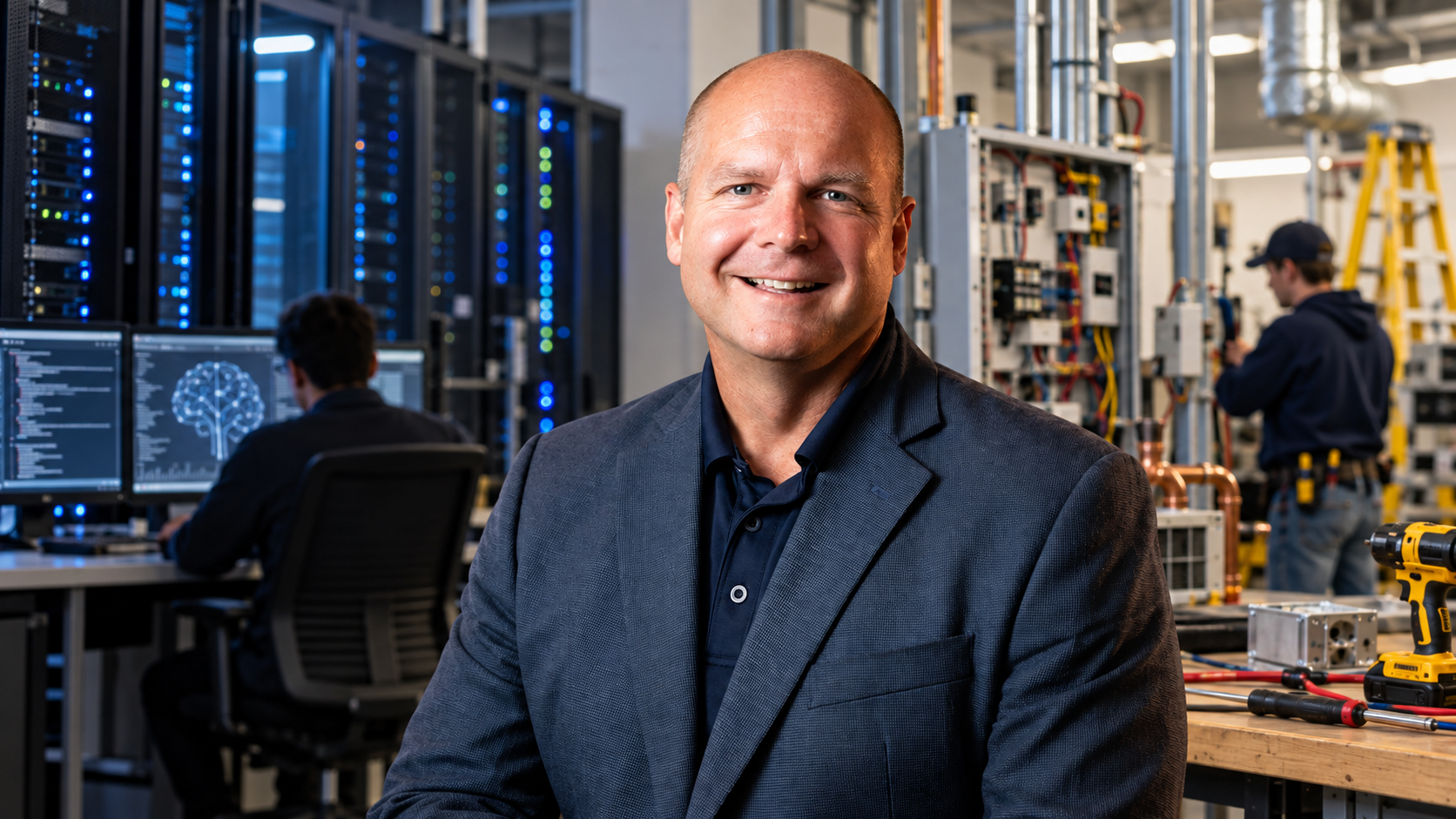
White-collar jobs could face major disruption from artificial intelligence, according to State Technical College of Missouri President Shawn Strong. He also says AI could make the future of white-collar jobs much less predictable.
State Technical College of Missouri President Shawn Strong has a Ph.D., an MBA and a bachelor’s degree.
But when he looks back at his own education, Strong says the best financial investment came first: his two-year technical degree.
“I always say that the best investment when I talk to our students coming in was that two-year technical degree,” Strong told Wake Up Jeff City. “Financially, I would have been a whole lot better off if I would have stopped with that Associate of Applied Science.”
Strong’s official biography shows that he started with an associate degree from Northwest Iowa Technical College before earning a bachelor’s degree, MBA and eventually a Ph.D. from Iowa State University.
That background makes his argument about the changing value of college harder to dismiss as simply anti-university rhetoric.
Strong runs a college. He has spent much of his career in higher education.
But when I asked whether the four-year college path has been oversold, he said the economics are becoming harder to ignore.
“There’s nothing wrong with a four-year education,” Strong said.
He argued that students who are genuinely passionate about a field can still do well pursuing a traditional degree.
The calculation changes, he said, for students choosing between a broad four-year degree and technical fields with immediate demand.
“If you’re not passionate about HVAC or electrical, you’re still going to have a job and you’re still going to make a lot of money,” Strong said.
How AI could disrupt white-collar jobs
Then the conversation turned to artificial intelligence.
“AI is going to blow up white-collar jobs,” Strong said. “We don’t know what’s coming.”
Strong said he already uses AI himself to research and understand problems before speaking with an expert.
His point wasn’t that every office job is about to disappear. He was making a broader argument about uncertainty: young people are choosing careers at the same time AI is changing what people can do, how quickly they can do it and which skills employers may continue paying a premium for.
State Tech keeps growing
That argument comes as State Tech is experiencing historic growth.
The Linn-based college welcomed 2,483 students for the fall 2026 semester, a 5% increase over the previous year and the school’s 10th consecutive year of enrollment growth, according to State Tech.
Credit-hour production increased another 8%, pushing full-time-equivalent enrollment to 2,609.
Strong said part of that growth comes from a shift in how parents view technical education.
He doesn’t believe students themselves have changed dramatically. What has changed, he said, is the old assumption among some parents that a child who doesn’t attend a four-year university somehow failed.
That attitude, Strong said, has “definitely swung” in the other direction.
The labor market gives families another reason to reconsider the old formula.
State Tech reports that 99% of graduates either find gainful employment or continue their education within six months of graduation.
And when Strong talks with employers, he says the problem usually isn’t finding enough jobs for graduates.
It’s finding enough people to fill them.
Jefferson City needs manufacturing and maintenance workers
I asked Strong to bring the conversation home to Jefferson City.
If a local employer came to State Tech asking for more workers, where would the need be greatest?
“Jeff City is no different,” Strong said.
He specifically pointed to manufacturing and maintenance, calling them two of the biggest workforce needs in Jefferson City and two of the hardest areas in which to interest young people.
The connection between State Tech and Jefferson City isn’t theoretical.
State Tech recently dedicated a new 40,000-square-foot Capital Equipment Building, recognizing a donation and longstanding partnership with Capital in Jefferson City. The building houses heavy equipment used in the school’s Heavy Equipment Operations and Management program.
For a city that routinely talks about workforce development, business recruitment and economic growth, State Tech is only about 25 miles down Highway 50.
Strong said the demand for workers extends well beyond just one or two programs.
Near the end of the interview, I asked what skill employers might be desperate for five years from now that high school students aren’t thinking about today.
His answer was that employers are already desperate now.
Strong said companies continue looking for communication and critical-thinking skills, but described just how low the baseline can sometimes feel.
“When you talk to HR people at least, they’ll say people that can just show up clean,” Strong said, calling that “a little bit disappointing.”
He quickly returned to critical thinking as one of the skills that matters most.
A student may train in electrical work, HVAC or another technical field and eventually move into a different job, Strong said. The ability to diagnose a problem, think through it and find a solution transfers with them.
AI may create demand for the trades it can’t replace
There is another wrinkle in Strong’s warning about AI and white-collar jobs.
Artificial intelligence may be digital, but the infrastructure required to support it is extremely physical.
Strong pointed to data centers.
Those facilities require enormous electrical capacity, utility infrastructure, manufactured equipment and workers capable of installing and maintaining all of it.
Strong said he expects data-center development to create significant demand over the next five to 10 years for utility programs and other technical fields.
“You’re building power plants, you have to manufacture everything for those power plants,” Strong said.
He argued that people often fail to consider the wider effect of massive infrastructure investments on companies producing physical goods and on the workers those companies need.
That creates an interesting contradiction in the AI jobs debate. He is also quick to point out that doesn’t mean white-collar jobs are disappearing overnight.
The same technology capable of reducing the amount of human labor required for some computer-based tasks may increase demand for electricians, utility workers, technicians, manufacturers and others responsible for building the physical infrastructure beneath it.
State Tech is already adapting to AI inside the classroom as well.
Strong said AI has so far changed how the college teaches more than what it teaches.
He described instructors using AI to build quizzes, develop lessons and help explain complex technical subjects. The college also plans to teach students about both the benefits and the pitfalls of the technology, including the possibility that AI can confidently produce bad information.
The college decision is getting more complicated
There’s an easy version of this debate where one side says everybody needs a bachelor’s degree and the other says college is a scam.
That isn’t the argument Strong made.
His argument is that students should know why they are going to college, what they are paying for and what the labor market may look like when they finish.
That matters even more when technology is moving faster than the traditional education-to-career pipeline.
For some students, a four-year degree will still make perfect sense.
For others, the calculation may increasingly point toward technical education and skilled work that employers are already struggling to fill.
State Tech’s enrollment suggests plenty of students are already reaching that conclusion.
The college’s next Show-Me State Tech Open House is scheduled for Saturday, Oct. 24, giving prospective students and families a chance to tour the Linn campus, technical labs and programs.
And if Strong is right about where AI and the labor market are headed, the old assumption that the four-year degree is automatically the safer bet may become much harder to make. The relationship between white-collar jobs and skilled trades could look very different in the next decade.