
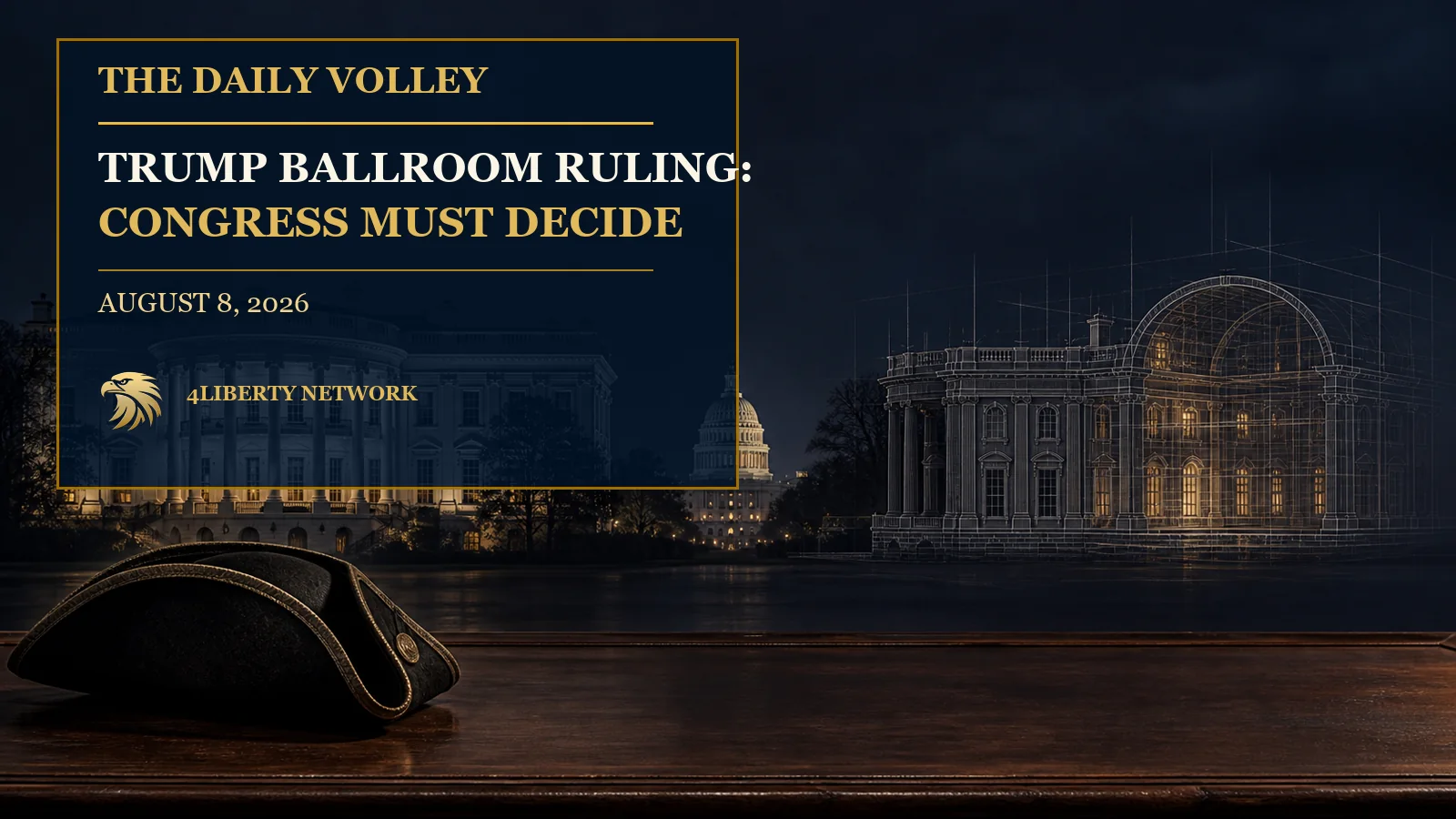
A divided federal appeals court says President Donald Trump cannot continue aboveground construction of a $400 million White House ballroom without authorization from Congress. The administration says it will appeal. The ruling is stayed for two weeks, leaving the next move with the Supreme Court or Congress.
The dispute is about more than a building. It tests the division of power over federal property, public money and the home every president temporarily occupies. Elsewhere, the White House has renewed its effort to remove Federal Reserve Governor Lisa Cook, Senator Bill Cassidy has improved Todd Blanche’s path to confirmation as attorney general, and Missouri’s back-to-school sales tax holiday is underway.
What the court ruled on Trump’s ballroom
The U.S. Court of Appeals for the District of Columbia Circuit ruled 2-1 on Friday that the administration lacks authority to keep constructing the ballroom without congressional approval. The Associated Press reports that the proposed structure would cover about 90,000 square feet and cost $400 million.
The panel’s order stops aboveground construction, but the court stayed its ruling for two weeks to allow an appeal. Trump said he would ask the Supreme Court to reverse the decision. That means the project is not permanently canceled, and the high court has not yet decided whether it will take the case or grant emergency relief.
The lawsuit was brought by the National Trust for Historic Preservation. The organization maintains a public case resource page with its filings and statements. An April D.C. Circuit order provides earlier procedural context, but Friday’s 2-1 ruling is the new event.
The disagreement is partly procedural. The majority accepted the preservation group’s path into court and concluded that Congress had not authorized the project. The dissent argued that the plaintiff lacked standing and criticized the lower court’s intervention. Those competing views may shape the administration’s Supreme Court request.
The X post above is historical context from March 31, when ABC News correspondent Jonathan Karl reported on the district-court stage. At the August 8 observation, the public post displayed about 32,300 views, 68 replies, 92 reposts and 443 likes. It is not a reaction to Friday’s appellate ruling.
Why the separation-of-powers question matters
The Constitution gives Congress authority over federal property and appropriations. Presidents direct the executive branch, but they do not personally own the White House or the money used to alter it. The appeals court’s institutional point is that a president occupies the property temporarily while Congress writes the governing law.
The administration can answer that argument in several ways. It can challenge the plaintiff’s standing, dispute the lower courts’ reading of the governing statutes, seek emergency relief from the Supreme Court, or ask Congress to authorize the project. The first three routes test the limits of judicial power and executive authority. The fourth puts the policy choice directly before elected legislators.
Supporters may see the ballroom as a privately funded improvement that would serve future presidents and state events. Opponents argue that demolition and reconstruction at the White House cannot be placed beyond congressional and preservation review simply because donors, rather than ordinary appropriations, supply the money. Friday’s ruling does not resolve whether a ballroom is desirable. It addresses who has legal authority to proceed.
For a related example of the same consistency test across executive power, see 4Liberty Network’s prior report on the administration’s narrower citizenship orders and their limits.
The White House renews its Lisa Cook removal effort
The administration is again trying to remove Federal Reserve Governor Lisa Cook. The Associated Press reports that White House aide Dan Scavino sent Cook a letter saying Trump was considering her removal and giving her until August 26 to respond to mortgage-fraud allegations. Cook denies the allegations.
The new notice follows the Supreme Court’s June 29 decision in Trump v. Cook. The Court denied the government’s request to lift an injunction protecting Cook. It concluded that she had been entitled to notice, some explanation of the evidence and an opportunity to respond before a final decision.
Sending a notice may address one procedural problem, but it does not decide the rest of the case. The governing statute permits a Federal Reserve governor to be removed only for cause. Courts may still have to decide whether the allegations, if proved, meet that standard and whether they have a sufficient connection to Cook’s official fitness.
The Supreme Court stressed the Federal Reserve’s unusual independence from day-to-day political pressure. That independence does not place a governor above accountability. It does mean that an allegation cannot automatically become legal cause merely because a president wants a different official. The new process should be judged by its evidence and the statute, not by which political side benefits.
Cassidy support changes the Todd Blanche vote count
Republican Senator Bill Cassidy said Friday that he will support Todd Blanche’s nomination for attorney general. The Associated Press reports that Cassidy’s decision likely gives Blanche a viable path to confirmation after other Republican senators expressed opposition.
President Trump sent Blanche’s nomination to the Senate on June 8. The Senate Judiciary Committee’s nomination page showed Blanche on the executive calendar during the research window. A final Senate vote had not occurred by the 3:12 a.m. CDT cutoff, so support should not be confused with confirmation.
Blanche is serving as acting attorney general and previously represented Trump as a criminal defense lawyer. Supporters argue that he is capable of managing the department and can use his relationship with the president to resist improper demands. Critics question whether a former personal lawyer can maintain the independence expected of the nation’s chief law-enforcement officer.
The Senate’s job is to test those competing claims. A confirmation vote should turn on judgment, legal independence and the nominee’s record, not merely access to the president or opposition to him.
UPDATE: Todd Blanche was successfully confirmed this morning.
Missouri’s weekend tax holiday
Missouri’s back-to-school sales tax holiday began Friday and ends at midnight Sunday, August 9. The Missouri Department of Revenue says qualifying items are exempt from state and local sales or use taxes during the period.
Price limits matter. The state’s consumer FAQ lists clothing at no more than $100 per item, school supplies at no more than $50 per purchase, graphing calculators at no more than $150, computer software at no more than $350, and personal computers or peripherals at no more than $1,500.
The exemption is for qualifying purchases, not a blanket discount on every item in a store. Internet purchases can qualify if the transaction is completed and paid in full during the holiday, even when delivery comes later. Buyers should check the state’s list before assuming a product is covered.
Going Viral
For a lighter closing beat, ameriCArtoon’s August 7 political-cartoon compilation turns recent Trump moments into a sequence of editorial cartoons.
What to watch next
– Whether the Trump administration files an emergency ballroom appeal with the Supreme Court during the two-week stay. – Whether Congress considers a specific authorization or funding measure for the White House project. – What evidence Lisa Cook receives and how she responds by August 26. Whether a fresh Missouri court filing advances the redistricting referendum dispute.
These stories share a common test: public power is legitimate when it follows the law, discloses its evidence and remains answerable to institutions outside one person’s control.
Research cutoff: August 8, 2026, 3:12 a.m. CDT. This report is a draft and was not published by the Morning Engine.