
by Brad Boeckmann
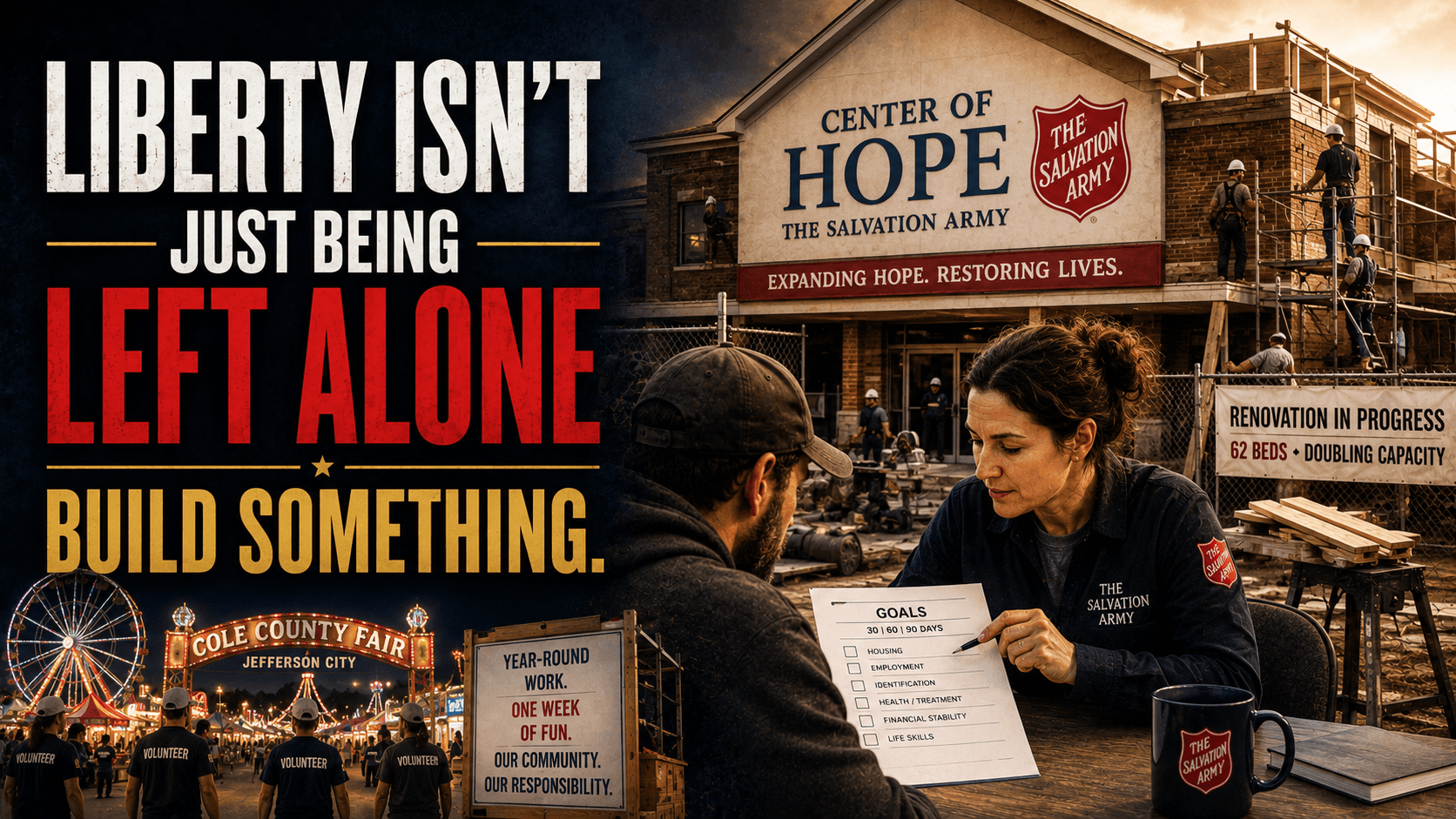
The Salvation Army expects to add 47 shelter beds in Jefferson City within roughly four months, bringing the Center of Hope’s permanent capacity to 62 before the coldest part of winter.
That’s the immediate story. The larger question is whether those beds will help people rebuild their lives or simply give them another temporary place to sleep.
Major Chris Clarke told me Tuesday that the first half of the Center of Hope renovation is complete. Current residents are moving into the renovated portion while construction begins on the other half of the building.
“We may have only 15 beds right now, but in just four months, we’re going to have an additional 47 beds,” Clarke said.
The original expansion called for 20 additional beds. Clarke said the Salvation Army added another 11 because its leaders didn’t want to complete the project and immediately find themselves full again.
“We don’t want to get back to where we’re full all the time,” he said.
That concern comes from experience. Clarke said the Center of Hope’s 31 beds generally met Jefferson City’s needs until the 2019 tornadoes. Over the past six years, however, the shelter has frequently operated at capacity and has had to turn people away.
The construction project has temporarily reduced capacity to 15 beds, but the Salvation Army condensed what was expected to be a three- or four-phase renovation so the full shelter could reopen faster.
The additional beds matter, especially with winter coming. But the strongest part of the Center of Hope model isn’t the number of beds. It’s the expectation that residents use their time there to move toward independence.
When someone arrives, staff members begin by figuring out whether the shelter is the right fit and what’s keeping that person stuck. That could mean finding work, getting identification, addressing addiction, applying for disability or veterans benefits, receiving medical care or finding somewhere affordable to live.
Residents then work with caseworkers to establish goals at 30, 60 and 90 days. Those goals aren’t imposed through one identical checklist. The residents help determine what they need to accomplish and how quickly they can realistically do it.
Some people may be ready to leave within three months. Others aren’t.
Development Director Melinda Jennings described one former resident who stayed for a year while completing roughly 40 different goals. That’s nearly one goal every week, each dealing with another problem that had kept the person from living independently.
“We don’t want to put Band-Aids on things,” Jennings said. “We really are about breaking the cycle.”
That’s where the liberty argument begins.
A free society doesn’t mean everybody retreats into private life while the community falls apart. It means people build institutions capable of helping their neighbors without abandoning standards, safety or personal responsibility.
The Center of Hope doesn’t allow active drug use inside the building. Violence or behavior that threatens other residents can result in someone being temporarily removed. That matters in a shelter serving families, children and other vulnerable people.
But removal doesn’t always mean permanent rejection.
Clarke said someone may still be allowed to receive meals and other services while temporarily unable to live in the shelter. The goal is to deal with the behavior and allow the person to return when it can be done safely.
Jennings offered the example of someone displaying aggression. The easiest response would be to label that person dangerous and send them away. But the behavior could be tied to untreated mental illness, medication problems or even unmanaged diabetes.
That doesn’t mean aggression can be ignored. It means solving the problem requires understanding what’s causing it.
“We meet them where they’re at without judgment or shame,” Jennings said. “We’re all human. We’re all going to fall down. What’s important is that we get back up again.”
That’s compassion with judgment. It protects the people already inside the shelter while recognizing that the person causing the problem may need help too.
It also avoids the two extremes that dominate so many political arguments about homelessness.
One side acts as though standards themselves are cruel. The other can be too quick to treat someone’s worst decision as proof that helping them is pointless.
The Salvation Army’s approach is different. Help people, but expect progress. Give people another chance, but don’t pretend rules don’t matter. Understand that someone can slip backward without turning every setback into either a permanent disqualification or a permanent excuse.
The organization is also changing how it handles case management.
Previously, some caseworkers worked only with shelter residents while others assisted people living elsewhere in the community. Those roles have now been combined into one social-services department.
That means someone who moves into permanent housing can continue working with the same caseworker who already knows that person’s history, goals and patterns.
“It is about trust,” Clarke said.
I spent years working as a caseworker, and that part stood out to me.
Building trust takes time. Starting over with someone new every time a client moves between programs may look efficient on an organizational chart, but it can destroy the relationship that made progress possible.
Keeping the same caseworker involved after someone leaves the shelter also gives the Salvation Army a better chance of catching problems before they become another housing crisis.
There’s still work to do on that front. Clarke said the Center of Hope successfully houses people at roughly twice the national average for shelters, but the interview didn’t produce a precise annual number. Jennings also acknowledged that the organization wants a stronger system for tracking whether former residents remain housed six months or a year after leaving.
That’s an important gap. It isn’t enough to know how many people leave the shelter with an apartment. We need to know how many are still there later.
That isn’t an attack on the Salvation Army. It’s what taking the organization’s mission seriously looks like.
Once all 62 beds are operating, Jefferson City will have a better opportunity to measure whether the expansion is enough and whether the program is producing lasting results.
Are people still being turned away? Is there still a waiting list? How many residents move into permanent housing? How many remain housed?
Those results will also help answer whether Jefferson City still needs another shelter through Room at the Inn.
Clarke didn’t completely rule that out. He said the Salvation Army believes 62 beds should meet most of the need it currently sees, but the full demand is difficult to measure because the Center of Hope has been full for so long.
“It is hard to say because we’ve been full for so long,” Clarke said. “We don’t know if people just hear, ‘Well, the Salvation Army is full,’ and they’re just not coming to us.”
That’s an honest answer. Jefferson City may not know the full need until the expanded shelter is open and there’s enough evidence to show who is still being left outside and why.
The funding discussion also showed why this project belongs in a broader conversation about liberty and strong local institutions.
Public money is involved. Jennings said the construction project received a $1.4 million grant from the Missouri Department of Economic Development and $100,000 from Cole County for a fire-suppression system.
But she said the majority of the campaign’s support has come from private donors.
“It really is the community who upholds us and allows us to be able to do this work,” Jennings said.
Clarke drew a distinction between public support for construction and the money used to operate the shelter every day.
“Since we’ve been here, we have not received one dollar for operating the shelter,” he said. “We definitely rely on the community to support our mission.”
That’s what strong civil society looks like.
It isn’t government disappearing while vulnerable people are abandoned. It also isn’t government assuming total responsibility for every human need.
It’s families, churches, businesses, donors, volunteers, charities and local institutions accepting responsibility for the community around them.
Those institutions still need rules. They still need transparency. They still need to show that what they’re doing works.
Accountability isn’t hostility. You can believe an institution is doing valuable work and still ask it to prove its results. In fact, that’s what responsible support should look like.
A nation capable of governing itself is built from the bottom up. It depends on people willing to give their money, time and attention to institutions that make their communities stronger.
Liberty isn’t just demanding to be left alone while everything around us falls apart. It’s helping people stand back up while still expecting them to take the next step.
Being left alone is part of liberty.
Building something is the rest of it.
Brad Boeckmann hosts Wake Up Jeff City on the 4Liberty Network. Reach him and watch all of the 4Liberty Network shows at 4LibertyNetwork.com.