
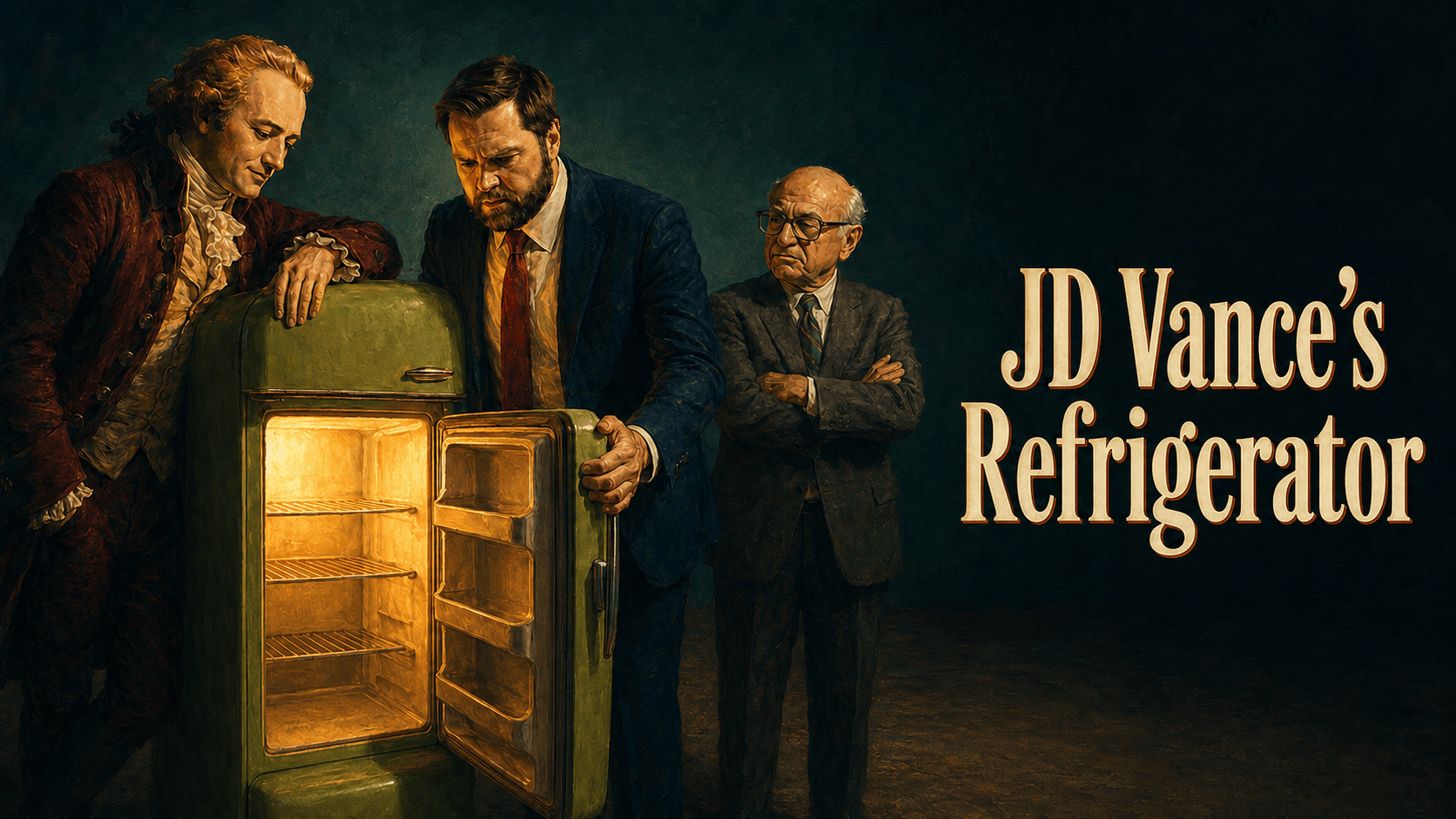
The JD Vance refrigerator story is where this whole debate over free markets really begins.
The Vice President is politically correct about almost everything he’s angry about. But is he technically correct?
In February of 2024, at a tech conference in Washington, JD Vance explained why he thinks economics is fake.
“We have a 40 year old refrigerator. And my takeaway from this whole purchase is that economics is fake. Because the refrigerator that we had, you would put lettuce in the icebox, and it would be good a month later… You cannot at any price point buy a refrigerator today that can do that.”
I have thought about that JD Vance refrigerator line more than any reasonable person should. It has the shape of every argument the Vice President has made since. It is vivid, it is intuitive, it is the kind of thing you nod along to while standing in your own kitchen… and it is not true.
Jeremy Horpedahl went and looked up the numbers on the JD Vance refrigerator. In 1984, a comparable refrigerator cost about $1,360, which was roughly 163 hours of work for the average American. The same class of machine sold for $998 in 2024 — about 33 hours — and even after a brutal price run-up to $1,658, it still only costs 53 hours. The average fridge has grown more than thirty percent since 1980, from 19.6 cubic feet to 25.8. It burns less than half the electricity: 1,415 kilowatt-hours a year down to 647.
And the durability collapse everybody swears they’ve witnessed? The share of American households still running a twenty-year-old refrigerator fell from 8.4 percent in 1990 to 5.5 percent in 2020. Real, but modest. Modest enough that what the average family actually did was trade some durability at the margin for a hundred and ten fewer hours of labor.
The JD Vance refrigerator is not a fake economy. That is one of the most humane machines ever built by trade and competition, and Vance used it as a prop to argue the opposite.
So when he sat down with Michael Knowles at the end of June and announced that Republican economics is “much more Alexander Hamilton than it is Milton Friedman,” and that this is “obviously a good thing” … yeah. I and others took it as a slap across the face. I’d be lying if I said otherwise.
But I’ve spent a month now reading everything the free market wing has fired back at him, and I’ve come to an uncomfortable conclusion.
They’re winning the argument he isn’t even having.
What He Actually Said About the JD Vance Refrigerator
Set the Friedman line aside for a second, because it isn’t even the most radical thing in that interview. Vance also said this:
“If you look at modern Britain and the result of Margaret Thatcher’s policies, you would say that her policies actually got Britain further away from that ideal and not closer to that ideal.”
Yikes.
And this:
“I think that meritocracy can steal from us a sense of what really, really matters.”
And another:
“The economy is a tool to service the dignity of the human person.”
Larry Kudlow, who has been doing this since before I was born, watched the whole run and essentially threw up his hands. “I don’t understand what he’s doing,” he said on Fox Business, “and I truly believe he needs to step back a moment for a great reset of his policy priorities.” Kudlow’s prescription… borrowing a phrase from Ben Domenech, was that Vance needs a “nineties summer.” Minimal screen time. Maximum outdoor time. Major family time.
Stephen Moore was less gentle. In Vance’s Daily Wire interview, Moore wrote, “he sounded much more like a Mitt Romney, big-government RINO than a Trump or Ronald Reagan.” He called the whole thing “anti-free-market, big government gobbledygook,” and landed on the line that’s going to follow Vance into the primary: the GOP has to be “the party of a lean and efficient and less burdensome federal government,” and if Vance doesn’t believe that, “maybe he’s in the wrong party.”
Robby Soave at Reason said the quiet part out loud: “Positing that free markets are somehow antithetical to human dignity is explicitly progressive framing.” He’s right, and that’s why Vance is getting the “he’s a socialist” jabs.
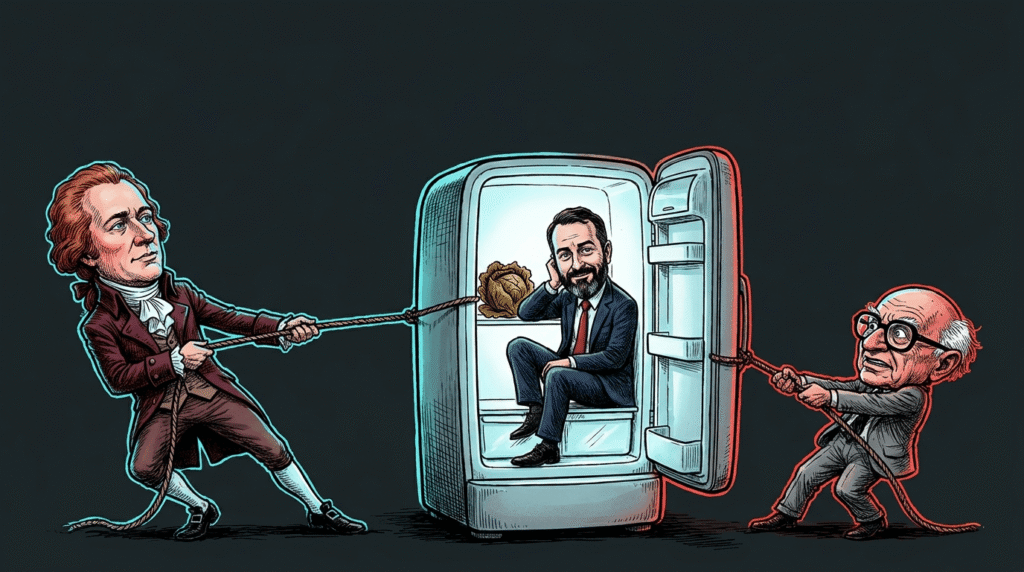
Then the money spoke. David McIntosh, president of Club for Growth, co-founder of the Federalist Society, posted on the Fourth of July that the Vice President was “dead wrong about both Milton Friedman and Alexander Hamilton.” The Club is chasing $175 million for this cycle. When the group’s spokesman told the Washington Examiner days later that McIntosh had merely been defending Friedman’s philosophy rather than criticizing the Vice President, it read to me less like a clarification than a flinch. Read it how you like. My read is that the money isn’t ready to fight Trump yet. It’s getting ready to fight Vance.
And Rand Paul had already, back in December, told Jonathan Karl on ABC that he intended to lead “a conservative, free market wing” of the party. Karl asked the obvious follow-up: and that’s not JD Vance?
“No.”
Where the JD Vance Refrigerator Argument Really Lies
I had Tom Pappert of the Tennessee Star on the show this week to talk through all of it, and Tom did something I wasn’t expecting. He didn’t defend the Friedman line. He changed the subject — and the subject he changed it to is the one I don’t have a great answer for.
“Young people cannot get jobs in this country. They’re being replaced by either H-1B workers, the jobs are being outsourced, and it’s difficult, not impossible, but difficult to get a house in this economy. So I think Vance is a bit playing to the base but he’s also identifying real problems that if you are a 20 to say 45-year-old man in America today you are very well acquainted with.”
Tom pushed back on the JD Vance refrigerator:
“You buy a refrigerator in 2026, and yes, thanks to our massive industrial sector in China, it’s now pretty cheap… But how long does it last? I know people who get 6 months out of a refrigerator and it’s leaking in the back and they bring the repair man and the repair man says, ‘Ah, we can’t get the part. It comes from China. Just buy a new refrigerator.’”
Here’s the thing. The data says Tom is wrong about the JD Vance refrigerator and right about the country. And I notice that when the free market right answers Vance, we almost always answer the correct way, but the unpopular way nonetheless.
Full Tom Pappert Interview
Akash Chougule wrote the sharpest version of the case over at FREOPP: “It isn’t the responsibility of the market economy — let alone of the government — to ensure meaning in a person’s life… Ultimately, markets are a mechanism for agency. They are not a replacement for family, faith, friendship, or community; that is, the real sources of fulfillment.”
That is philosophically airtight and absolutely correct… and it will absolutely land on a twenty-six-year-old man with three roommates and a degree he’s still paying for like a wet fart.
Because that 26-year-old man never asked the market to give his life meaning. He asked it for a house.
The cure is the disease
So let me concede the whole indictment and then explain why I still think Vance has this backwards.
Everything Tom described is real. The offshoring. The H-1B displacement. The housing market is a generational catastrophe. Young men in this country are not imagining that the deal their fathers got is no longer on the table.
None of it is an indictment of the free market, because we have not had one in living memory.
Tom conceded this himself, on air, and I think it’s the most important thing either of us said:
“Anybody watching this show knows that we do not live in a real free market economy. And that’s part of the problem just as much as the government meddling and essentially giving rewards to their allies is part of the problem.”
Right. So what does Vance propose? More meddling. More rewards to allies — just different allies. A federal hand on the tiller of the AI economy. Tariffs not as emergency leverage but as, in his own words, “the baseline position that virtually every Republican politician adopts.” An economy steered toward moral outcomes chosen by whoever happens to be holding the wheel.
The JD Vance Refrigerator Cure Is the Disease
Hamilton wouldn’t have handed it over either. Dmitri Bolt made this point at Townhall. Hamilton’s protectionism was temporary, aimed at infant industries, with liberalization as the endpoint — and in the same Report on Manufactures Vance’s people love to cite, Hamilton called foreign capital flowing into American industry “a precious acquisition,” something to be treated “as a most valuable auxiliary” rather than as a rival. Vance is quoting a man who wanted a ladder and building a wall.
Conn Carroll made the best case for the other side over at the Washington Examiner. Vance’s deeper claim isn’t really economic at all. “Free institutions and free markets do not sustain themselves,” Carroll wrote. “They depend upon a people shaped by common habits, loyalties, moral restraints, and institutions capable of preserving them.” Markets require a culture that markets don’t produce. That’s a serious argument. It’s the one Friedman’s critics have always made, and it’s why Vance’s line about the 1980s still having “a very rich and powerful institutional Christianity” is more interesting than his critics allow.
But notice what it isn’t. It isn’t a policy. It’s a mood. It’s about “feeling” your politics, not thinking them through.
The worst possible week to pick this fight
Here’s what makes all of it stranger. Vance did this while his own numbers were collapsing — and collapsing for reasons that have nothing to do with Milton Friedman.
In February, before the shooting started with Iran, Emerson had him at 52 percent among 2028 Republicans, with Marco Rubio at 20. As of last week: Vance 39, Rubio 38. In New Hampshire, UNH had it 53-7 in February. Now it’s 36-26.
The war did that. Not the economics. And the cruelest detail is that Vance was right about how the war would land. The public opposes it 59 to 33 in Nate Silver’s average, Trump’s handling of Iran sits at 34-66 in Fox’s own polling, and only 28 percent tell Washington Post/Ipsos it was worth fighting. Vance called it, and dropped thirteen points anyway, while the Secretary of State selling it gained eighteen.
Peter Laffin, writing sympathetically, put his finger on the real problem: something like 80 percent of Republicans still tell pollsters they want a free market candidate. “There will be no coronation,” Laffin wrote. “Vance doesn’t seem to want one. He’s spoiling for a fight.”
He’s building a coalition that doesn’t exist yet, out of parts he’s taking from the one that does.
What I actually want
Bill Maher told Jonathan Karl on ABC last week that yes, he could see himself voting for JD Vance, if this is where the Democrats are going. That’s a conditional, and the condition is doing a lot of work. But Tom’s right that five years ago nobody would have believed the sentence at all. There is a large constituency out there for what Vance is gesturing at, and it doesn’t map onto anything the last forty years of Republican politics knows how to talk about.
So I don’t want him to shut up. I want him to argue and make better points. Better points than “economics is fake,” at least.
Here’s the thing that keeps nagging at me, a month and a hundred articles into this: Vance has not answered a single one of these people on the merits. Not Kudlow. Not Moore. Not Soave. Not McIntosh. Not Chougule. No reply from his office, no follow-up essay, no interview where somebody who knows the material gets to press him on what Hamiltonian economics means when the tariff revenue dries up and the federal stake in AI becomes a Democratic slush fund. He said the thing, he went on Rogan and talked about giving workers “a say in what’s going on,” and he never came back to it.
Tom’s charitable read is that Vance is speaking in broad terms to reach people who don’t own dictionaries that the right is “too smart,” too invested in definitions, and that the man is trying to talk to a country where the words themselves have come unmoored from their meanings. Tom’s not wrong about that. Gallup finds “free enterprise” viewed positively by 81 percent of Americans and “capitalism” by 54. Echelon has “free market economy” at 53-12 favorable and “capitalism” at 49-29. Rasmussen found that 48 percent of the people who like socialism also like capitalism. Tom may be describing the smartest political instinct in American politics right now.
But I keep coming back to the JD Vance refrigerator. Because whatever else that was, it wasn’t an attempt to reach anybody. It was a man who knows better, telling a story he knows is thin, because the story feels true and the numbers don’t.
A hundred and ten hours, Mr. Vice President. That’s what the JD Vance refrigerator bought back for a working family. You can believe the economy should serve the dignity of the human person. I do, and I can still notice that a hundred and ten hours is a lot of dignity.
Make the argument. The JD Vance refrigerator moment shouldn’t be the last word. We’re listening. Some of us have been waiting a long time for somebody on our side to take the twenty-six-year-old seriously, and it is maddening to watch the one guy who does get it wrong on purpose.
Austin Petersen is the founder of the 4Liberty Network, host of the Wake Up America show, and infrequent guest on Fox News.
Tom Pappert is the lead reporter at the Tennessee Star.