
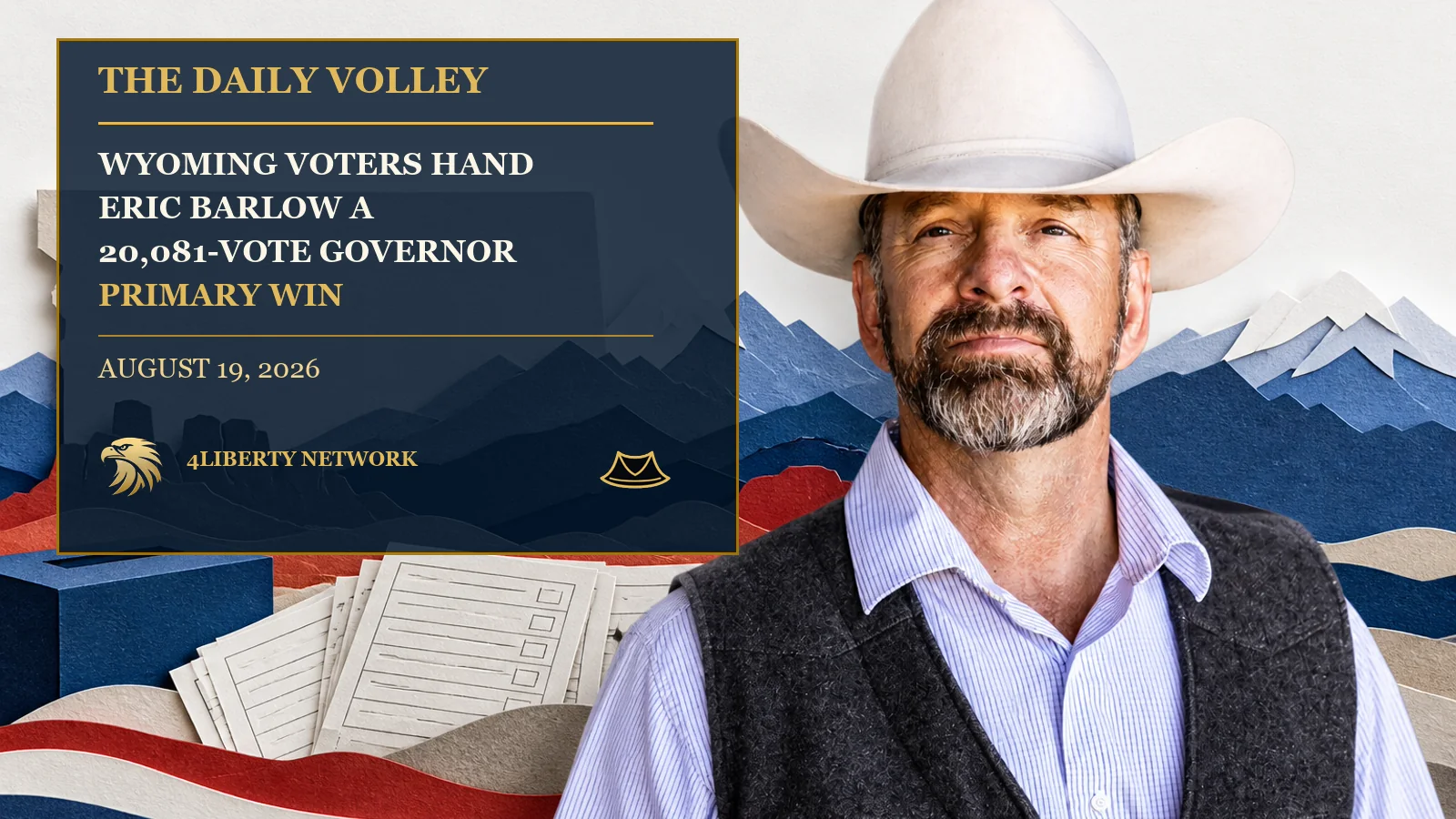
Wyoming Republicans gave Eric Barlow 58,820 votes Tuesday and a 20,081-vote win in the governor primary.
The Wyoming Secretary of State’s statewide tally had all 23 counties reporting shortly after midnight Mountain time. Barlow took about 45 percent of the named-candidate vote. State Superintendent Megan Degenfelder finished second with 38,739, followed by Brent Bien with 30,843 and Curt Blake with 2,161. The result remains unofficial until the canvass.
Degenfelder had President Donald Trump’s endorsement. Barlow had something less portable: 14 years in the Wyoming Legislature, including a term as House speaker, plus a campaign built around showing up in the towns that a national political operation cannot fake knowing.
“Show up, do the work, get the job done,” Barlow said after the race. He called that the rule on his ranch, the rule he followed in the Legislature and the rule he intends to bring to the governor’s office. His campaign platform joins limited government to decisions made close to home, especially on energy, water, public lands, rural health and property rights.
Barlow said he prevailed despite “out-of-state money and outside voices.” That is his reading of the result, not a fact recorded on a ballot. He was an experienced lawmaker with serious fundraising of his own. Degenfelder was an experienced statewide official. Wyoming voters still made a clear choice between them.
Barlow now faces Democrat Ken Casner in November. Republicans hold a roughly 7-to-1 registration advantage in Wyoming, but Tuesday’s lesson arrived before the general election: even in one of the nation’s reddest states, an endorsement from Washington does not relieve a candidate of the work back home.
ABC Takes the FCC to Court
ABC does not need to be your favorite network for its First Amendment case to matter.
Disney, ABC and eight ABC-owned stations sued the Federal Communications Commission on Tuesday. They want a federal judge to stop the agency from forcing the stations through an early license-renewal proceeding.
The FCC’s own notice says the licenses normally would not come up for renewal until 2028 at the earliest. The agency called them in early while investigating whether ABC’s employment practices violate federal discrimination rules.
ABC alleges that the investigation is a pretext for punishing coverage and programming the Trump administration dislikes. The FCC answers that every broadcaster using public spectrum has a duty to serve the public interest, “even Disney.”
A judge has not decided who is right. Broadcasters using public spectrum remain subject to neutral law. The First Amendment also bars a president from using licensing power to punish jokes, interviews or reporting that make him angry.
Missouri Watch
John Combest’s Tuesday roundup points to two facts in Missouri’s redistricting petition fight that must be kept separate.
First, a Cole County judge excluded roughly 32,600 signatures gathered before Gov. Mike Kehoe signed the new congressional map. The judge found that voters could not circulate a referendum against a bill that had not yet become law.
Second, the later signatures still appear to clear the required threshold. The Secretary of State’s county reports and original reporting by the Missouri Independent show enough verified names in the required congressional districts.
That does not put the referendum on the November ballot. A separate trial Wednesday will decide whether Secretary of State Denny Hoskins may block it as unconstitutional. The state says congressional redistricting belongs to the Legislature. Organizers point to Missouri’s broad referendum language and a state redistricting referendum held in 1922. The next ruling will decide whether voters get the last word this year.
From the 4Liberty Network
Economist Phil Magness told Austin Petersen that J.D. Vance’s skepticism toward a strong dollar is “protectionism playing with fire.”
On Wake Up America, Petersen pressed the argument all the way to the kitchen table. If global demand for dollars falls, what happens to mortgages, credit cards and groceries?
A strong reserve currency can make American exports more expensive and deepen the trade deficit, the problem Vance emphasizes. Magness argues that weakening demand for dollars can raise borrowing costs and the price of imported goods. Producers, borrowers, savers and consumers would not bear those effects equally.
Going Viral
MEME THE LEFT takes the old escape hatch, “that wasn’t real socialism,” and runs it through a new rapid-fire compilation.